Monday Morning Motivation
Time for a little Monday Morning Motivation…
How will you be better this week than last?
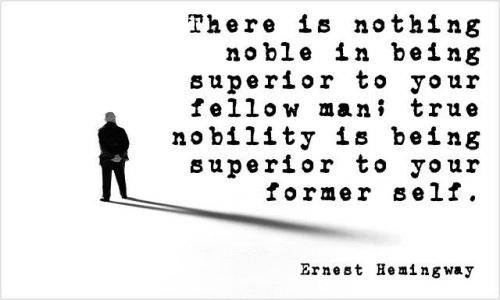
Onward & Upward!
Make a Great Day!
Steve

Time for a little Monday Morning Motivation…
How will you be better this week than last?
Onward & Upward!
Make a Great Day!
Steve

Good Day Folks,
As a professional sales/customer service trainer, I’m often approached by individuals seeking the right foods to power their pinnacle performance.
Actually that has never happened but it does bring up a good point.
Today is National Doughnut Day!
It’s true. See this report from ABC News that includes where you can get free doughnuts today > National Doughnut Day 2013: Where to Get Free Doughnuts
Assuming you have not run out of the building to your local doughnut retailer and are still reading this I will add that doughnuts would not be my first recommendation as an energy-driver power food. However, there is something to be said (something good) about the personal enjoyment derived from a good glazed pastry with a hole in it.
Or perhaps your more of a creme or jelly filled sans-hole type of doughnut connoisseur? No worries, they have plenty of those to please the most demanding pallet.
There is some logic, albeit fuzzy, at work here too. Doughnuts put you in a good mood. It’s just hard to miserable eating one. And when you’re in a good mood “Positive Attracts Positive” and everything goes better.
Besides, you work hard. That’s what Pinnacle Performers do. You deserve a delicacy now and then. Consider it a just reward for a job well done this week.
Make mine a powdered chocolate warmed (but not too hot) with some strawberry cream dipping sauce!
Steve 🙂

As a professional sales/customer service trainer, I work with many businesses that sell (or have opportunities to sell) both face-to-face and on the phone. Of course, from a development perspective, both of these point-of-sale areas need to be addressed with an effective methodology and a process institutionalized to maximize selling opportunities.
But what area is more important, face-to-face or on-the-phone? I can attest with unwavering certainty, that for businesses where the same employees sell both ways, the phone is by far the more important of the two areas. In fact, I often paraphrase Sinatra’s famous line when speaking about telephone relations to my training clients: “If you can make it here, you can make it anywhere.” Why are phone skills most important?
Here are my Top 3 Reasons:
1) Resistance is Greater
Simply put, selling face-to-face is easier. When a prospective customer takes the time and effort to visit your store or office they have made a higher level commitment to buying from your business than they would have simply phoning in. More often than not a prospective customer’s visit is premeditated, they have determined in advance that you can provide what they need/want and arrive with the intent to buy.
That’s not to say that salespeople don’t lose face-to-face sales opportunities as this is a regular occurrence in companies where the salespeople are not well trained and/or don’t follow an effective sales process. It’s just easier as face-to-face customers’ resistance is typically much less than the phone-in prospect that is often just ‘calling around’ for pricing and specifications.
2) Escape-ability is Higher
When a customer is face-to-face they cannot easily do anything but interact with you and other members of your team. When a customer phones the business expressing purchase consideration in your products and/or services it is extraordinarily easy for them to disconnect and call one of (or all of) your competitors at light speed if they are not effectively engaged.
Human nature plays a role here too. There’s an emotional element when two people interact face-to-face that doesn’t exist on the phone. Accordingly, it’s considerably easier to hang-up and end a phone interaction than it is to walk out on someone face-to-face.
Add in the fact that (to point #1) they took the time and effort to visit your location, most customers are far more willing to stay put and try to make a deal even if the interaction with their salesperson is less than a high quality experience. Contrast that to a phone interaction where if the caller is not engaged and/or doesn’t feel they’re receiving the best service to meet their needs they can swiftly move on to the next service provider with a few clicks.
3) Communication Deficit
While number one and two have a major impact, the single biggest reason phone skills training is most important in sales is in communication itself.
As you may know, there are 3 elements that compose communication; words, tonality and body language. In face-to-face interactions, salespeople have all of these communication tools at their disposal to maximize their selling capability. Conversely, on the phone, the single biggest component of communication, physiology (body language) is absent and the salesperson must rely only on what they say (words) and how they say them (tonality).
For these reasons, any business that has salespeople that sell both on the phone and face-to-face should emphasize phone skills training and development to offset the disadvantages and maximize their sales opportunities!
Printable PDF of this article > Top 3 Reasons Why Phone Skills are Most Important in Sales
Now that we’ve covered the importance of phone performance, what should you and your team be doing on the phone to maximize results? Plenty and much of it is covered in this Tire Review magazine cover story featuring yours truly > Phone Skills Drill
Have a look and, by all means contact me if your team needs help with phone skills to win more customers for your business
Make a Great Day!
Steve 🙂
—
Steve Ferrante is the CEO & Trainer of Champions of Sale Away LLC., providing Pinnacle Performance Sales, Customer Service and Winning Team Culture training, speaking and professional development services to success-driven businesses throughout North America. For more information on Steve and Pinnacle Performance services for your team visit saleawayllc.com

I love Amazon! Over the past 10 years or so, I have purchased countless items from Amazon.com; books, office supplies, DVD’s, electronics, coffee, assorted gifts and a lot more. In fact, rarely does a week go by without at least one Amazon package arriving from UPS. I even have my own “Recommended Reading Store” powered by Amazon.com. You can (and really should) visit it here > Steve’s Recommended Reading
Apparently, I am not alone in my infatuation with the company. In the published 2011 Temkin Experience Ratings, Amazon was ranked #1 in customer service out of 143 large companies across 12 industries. According to Temkin, the results were based on feedback from 6,000 US consumers that evaluated three components of the customer experience:
Anyone who has participated in my Pinnacle Performance Training can tell you this is remarkably similar to my teachings of the ingredients of a properly balanced world-class customer service organization. Far too often, I see businesses that focus too much attention on meeting customers “functional” needs, compromising or outright neglecting the “emotional” aspects of the customer experience.
As I have stated many times, great customer service is a feeling thing; it’s how the customer feels when they’re doing business with you and, more importantly, how they feel and the stories they tell when they’re done. Amazon figured this out and committed to consistently delivering a complete customer experience.
Speaking on Amazon’s customer-centric philosophy and success, Jeff Bezos, CEO of Amazon, said;
“If there’s one reason we have done better than of our peers in the Internet space over the last six years, it is because we have focused like a laser on customer experience, and that really does matter, I think, in any business. It certainly matters online, where word of mouth is so very, very powerful.”
Here are a few Amazon best practices that every business can also do to improve the customer experience, customer retention and sales:
When you purchase an item (any item) from Amazon, you will often receive an email back that reads “customers that purchased what you just purchased are also interested in these items”. Every time you visit their website and search for an item you are also shown alternative items that other customers have ultimately purchased. These types of recommendations personalize the customer experience and make customers feel like someone is paying attention and is interested in helping them. Speaking from personal experience, Amazon not only knows my buying history they use it effectively to introduce me to other items aligned with my interests.
How well do you monitor and manage your customers specific service/product purchase potential? How well do you communicate this with them in ways that do not feel generic or one-size-fits-all?
One of the biggest consumer grievances in all of customer service is the lack of progress updates once a business transaction is underway. This is especially true of service providers where consumers typically experience anxiety and frustration when they are not kept informed of developments with their job.
This issue rarely, if ever, occurs at Amazon. Place and order and you’ll receive an instant email with your order confirmation and estimated time of delivery. Not long after that first email, you’ll receive another with your shipping information and tracking number. Any questions along the way can easily be administered by email or, if you prefer, by calling a real live human-being on their customer service line.
Do you practice pro-active customer-contact? When customers are waiting for service, do you check-in with them and provide progress updates? Do you phone customers if their service may be longer than originally anticipated?
Amazon apparently understands a fact I reference in my training; keeping your existing customers is cheaper and more profitable than getting new ones. Accordingly, they have created a rewards program that, well, rewards customers for their loyalty. As an Amazon Rewards card holder, members receive points on purchases transacted with the card and can then apply those points as rebate dollars towards future purchases – something I regularly do!
Amazon is not alone in this endeavor. Most industry-leading retail and service companies have some type of customer rewards or loyalty program. Why? Because they work to strengthen the customer relationship, make customers feel that their business is valued above and beyond the transaction at hand, and provide an added incentive to continue the relationship.
What does your customer rewards program look like? If you don’t have one, why not? Are you losing business to competitors that may be benefiting from their program?
As I wrote in my Winning and Losing with Customer Complaints article in Tire Review magazine, the true test of a business’s customer service effort is not when things are going right – but rather what is done when things go wrong.
Consider this personal experience I had while attempting to purchase an MP3 player as a Christmas present for my daughter. Below is the self-explanatory communication between myself and Amazon customer service.
Me
My MP3 product was delivered today. It arrived in a thin white box with “BP Consulting” on the return address. I opened it and was (still am) shocked and upset to find the product in a plastic bag with PC connecting wire and headphones – that’s it. There is no original product packaging, user manual, mfg info, etc. I will leave packaging feedback with photo shortly. This is a gift, and I can’t give it as is. Looks like I purchased, discarded packaging, used and re-gifted this way.
Very Disappointed and Need Resolution ASAP (or sooner)
Actual response from Amazon.com Customer Service (received 3 hours after original message)
Hello,
I’m sorry to hear if your MP3 disc player arrived that way. This usually doesn’t happen. We make every attempt to package items securely to protect them during shipping, but sometimes cases like this occur.
We always appreciate customer input on how we can improve our store, and I’ve forwarded your message to our shipping department.
I want to make this things right for you, so I’ve requested a full refund of $79.99 for the MP3 disc player, since you received the item that way. This refund will appear as a credit on your American Express card in the next 2-3 business days.
We look forward to seeing you again soon.
Did I solve your problem?
Best regards,
Donna A.
Amazon.com
This response is right on many levels; there’s empathy, appreciation, no blame, accountability and action. You’ll notice I didn’t ask for a refund but that’s exactly what I received. Customer service champs like Amazon realize it is far better to lose a little bit now then it is risking the loss of a customer for life.
Do you have a customer-first complaint resolution process? Do all your employees understand it? Are they empowered to use it?
Amazon practices world-class customer service every day. Following their lead can make a real difference in your business results as well!
Steve
Good Day Pinnacle Performers,
Welcome to May! Hope this post finds you doing extraordinarily well.
We have arrived at the last in the series of John Wooden Maxims:
“Things turn out best for the people who make the best of the way things turn out.”
Excerpt from Wooden: A Lifetime of Observations and Reflections on and Off the Court:
“Why is it so much easier to complain about the things we do not have than to make the most of and appreciate the things we do have?”
This quote ties directly into the Maxim as many folks don’t make the most of the way things turns out, instead focusing on and complaining about what is missing and/or wrong with the situation.
This is a lesson I personally lived out in my professional selling efforts. When I started in business management consulting sales, I was assigned a territory that was considered to be “saturated”, having gone through many years with many different sales reps before me calling on what was, by and large, the same prospective client base. At the same time, there were brand new “virgin” territories in other areas of the Eastern U.S. that afforded the sales reps there opportunities to get in front of potential clients for the very first time. In a new territory, it was not uncommon for the salesperson who worked there to receive (from the company’s inside sales effort) twice the number of appointments in any given week.
It would have been quite easy to focus on those negatives; I can’t sell because the territory is saturated, I can’t sell because the prospects I’m seeing have seen us 14 times already, I can’t sell because I’m getting half the appointments, etc.
Instead I chose (with some effective mentoring at the time) to focus on what I did have and could control. If I had less opportunities and the opportunities themselves would potentially be of lower quality, well then I needed to be all that much better with the opportunities I did have or I would surely fail. I’m happy to report that was not the case…
Over my 10 years with the company, I maintained the highest batting average (sales to presentation ratio) and ended my tenure with the highest generated revenue totals in the company’s history.
One thing is certain. You will have challenges. You will have obstacles. In order to succeed you must build a mental bridge and get over them. What John Wooden said is true:

Make a Great Day!
Steve 🙂
Sad Day Here in Boston Folks…
In the aftermath of the tragic Boston Marathon bombings there is a dark cloud lingering over the city as our community tries to make sense of what was a senseless, heartless, maddening act of violence. Certainly the thoughts and hearts of everyone in New England and throughout our U.S. of A go out to the victims and their families. Personally, I hope those tasked with tracking down the attacker(s) are soon successful and justice is swift and the penalty severe.
If there’s a bright side to this shocking tragedy it is how the worst of times often bring out the best in many of us. That was certainly the case yesterday as Bostonians as well as countless individuals that had traveled in from out of the area for the marathon united for a common cause; to lend a hand and do what they could to help those in need.
Although it’s tough to make constructive comparisons to something so terrible, I was reminded yesterday of the connection to customer care. As I have written about, teach and preach to my clients, the true test of a business’ customer service fitness is not when things are going right but rather what is done when something goes wrong. Well something certainly went wrong yesterday.
With that in mind, I received the following message via email yesterday from one of my favorite ‘Pinnacle Performance’ companies, JetBlue, yesterday:
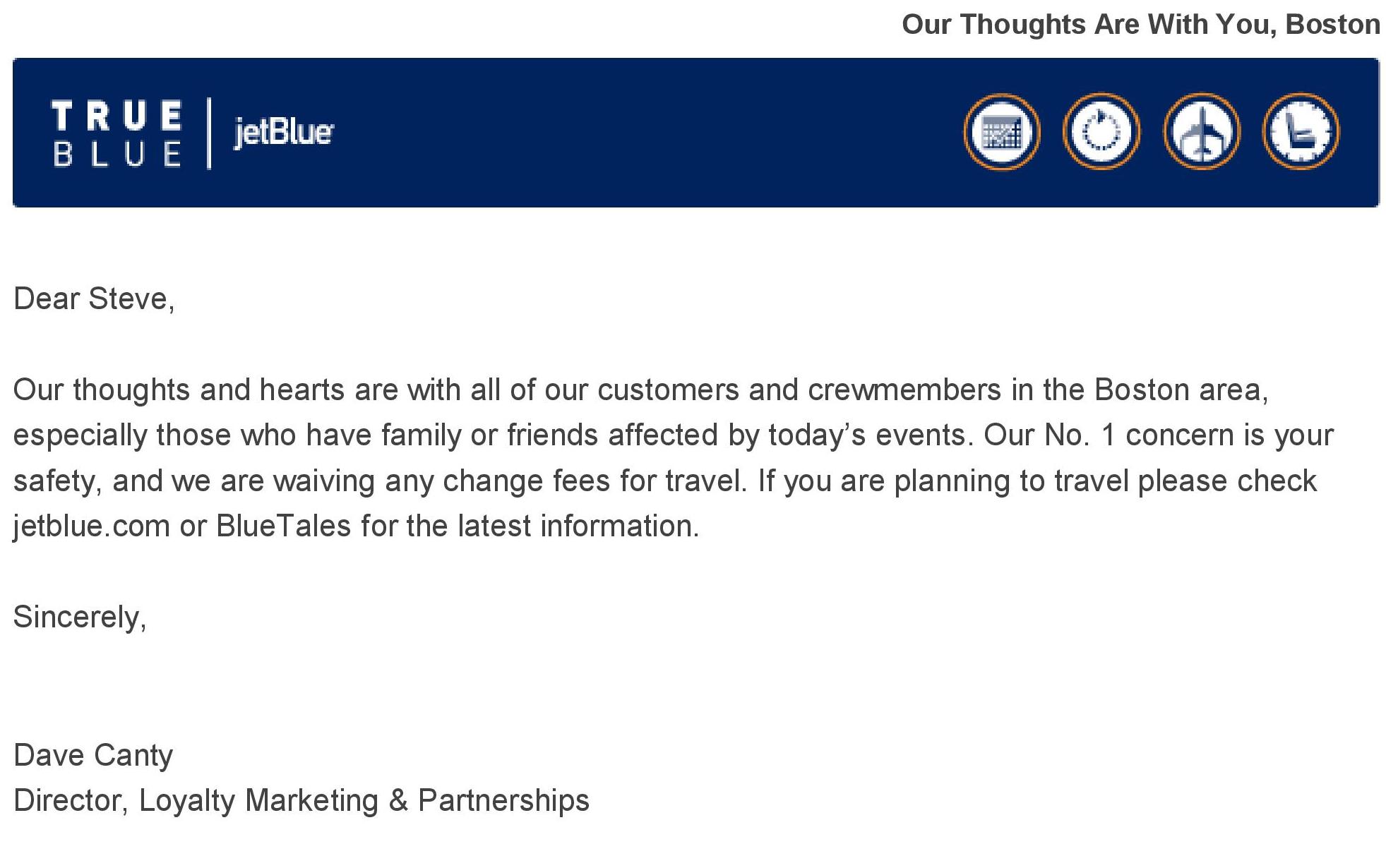
While it’s doubtful that any of us in customer service (and we’re all in customer service in one way or another) will have to deal with anything approaching something as tragic as the attacks in Boston, all customers have needs and it is how we deal with these needs, the empathy we demonstrate and the customer care we execute that makes all the difference.
Wishing You Well
Steve
Good Day Pinnacle Performers,
Time marches on and with it we have arrived at the next John Wooden Maxim: It’s what you learn after you know it all that counts.

This popular Wooden maxim is the first quote I reference with new trainees. While select students are novice, inexperienced lads and ladies, most folks enter training with at least several years of experience, up to seasoned veterans with 10+ years on-the-job.
Many of these experienced folks enter new training with a know it all already mentality, seemingly close-minded to new ideas. Obviously this is not the most favorable attitude when it comes to learning anything.
Fortunately, the vast majority of participants in my Pinnacle Performance training do come around. Usually at some point during our first time together they realize they actually didn’t know this or that and, now that they do, they’re better for it.
“Always be learning, acquiring knowledge, and seeking wisdom with a sense that you are immortal and that you will need much knowledge and wisdom for that long journey ahead. Know that when you are through learning, you are through.” – John Wooden
The reality is you can’t learn anything if you already know everything.

Those know it all types aren’t particularly interested in moving forward and growing, contending that if they don’t know it by now then they never will.
Pinnacle Performers maintain an open-mind and pro-actively seek out new learning opportunities and ideas that can help them further their skill set and performance.
Looking to learn more? Visit Steve’s Recommended Reading
Make a Great Day!
Steve
Good Day All,
As my Pinnacle Performance pupils well know, there are many elements that make up an effective “Winning Team” culture as I wrote about here > The Great Eight Practices for Creating a Winning Team Culture
Of these, the most important is effective leadership that leads by example, supports and manages effective team member behaviors, and drives morale and motivation.
For a reverse perspective, below is an excellent article from Jack and Suzy Welch that outlines six areas that work against effective leadership and impede the successful development of a winning team culture.
Make a Great Day!
Steve 🙂
By Jack and Suzy Welch
Being a leader is perhaps the hardest challenge any of us will ever face. No matter how long we work at it, practicing the right behaviors is a never-ending task. Knowing – and avoiding – the wrong ones is too. Thus, we offer the following six common leadership pitfalls:
1. Not Giving Self-Confidence its Due.
Self-confidence is the lifeblood of success. When people have it, they’re bold. They try new things, offer ideas, exude positive energy, and cooperate with their colleagues instead of surreptitiously attempting to bring them down. When they lack self-confidence, it’s just the opposite. People cower. They plod. And they spread negativity with every word and gesture.
But all too often leaders ignore (or neglect) this very basic fact of the human condition. Why is anyone’s guess. Perhaps they just don’t understand that it is part of their job to instill self-confidence in their people. It may even be said that it’s their first job. You cannot unleash the creative power of individuals who doubt themselves.
Fortunately, some people seem to be born with self-confidence. Others gain it from life and work experience and come to a company fully loaded. Regardless, leaders can never stop pouring self-confidence into their teams. The ways to do so are myriad. Make sure goals are challenging – but achievable. Give effusive positive feedback. Remind your direct reports of what they do right.
We’re not saying that leaders should blindly extol and exalt. People know when they’re being gamed. But good leaders work relentlessly to find ways to instill self-confidence in those around them. They know it’s the gift that never stops giving.
2. Muzzling Voice.
Perhaps the most frustrating way that leaders underperform is by over-talking. That is, they act like know-it-alls. They can tell you how the world works, what corporate is thinking, how it will backfire if you try this or that, and why you can’t possibly change the product one iota. Sometimes such blowhards get their swagger from a few positive experiences, but usually they’re just victims of their own destructive personalities.
Ultimately, the company ends up being a victim too, because know-it-alls aren’t just insufferable, they’re dangerous. They don’t listen, and that deafness makes it very hard for new ideas to get debated, expanded upon, or improved. No single person, no matter how smart, can take a business to its apex. For that, you need every voice to be heard.
3. Acting Phony.
Can you spot a phony? Of course you can – and so can your people. Indeed, if there is one widespread human capability, it is sniffing out someone who is putting on airs, pretending to be who they’re not, or just keeping their real self hidden. Yet too many leaders spend way too much time creating personas that put a wall between them and their employees. What a waste.
Because authenticity is what makes people love you. Visibly grappling with tough problems, sweating the details, laughing, and caring – those are the activities that make people respond and feel engaged with what you’re saying. Sure, some people will tell you that being mysterious grants you power as a leader. In reality, all it generates is fear. And who wants to motivate that way?
Now, obviously, authenticity is unattractive if it’s coupled with immaturity or an overdose of informality. And organizations generally don’t like people who are too emotionally unbounded – i.e. so real that all their feelings are exposed. They tend to tamp that kind of intensity down a bit. And that’s not a bad thing, as work is work and, more than at home, allows us to maintain some privacy.
But don’t let convention wring all the authenticity out of you, especially as you climb the ladder. In time, humanity always wins. Your team and bosses come to know who you are in your soul, what kind of people you attract and what kind of performance you want from everyone. Your realness will make you accessible; you will connect and you will inspire. You will lead.
4. Lacking the Guts to Differentiate.
You only have to be in business a few weeks to know that not all investment opportunities are created equal. But some leaders can’t face that reality, and so they sprinkle their resources like cheese on a pizza, a little bit everywhere.
As a result, promising growth opportunities too often don’t get the outsized infusions of cash and people they need. If they did, someone might get offended during the resource allocation process. Someone – as in the manager of a weak business or the sponsor of a dubious investment proposal.
But leaders who don’t differentiate do the most damage when it comes to people. Unwilling to deliver candid, rigorous performance reviews, they give every employee the same kind of bland, mushy, “nice job” sign-off. Then, when rewards are doled out, they give star performers little more than the laggards. Now, you can call this egalitarian approach kind, or fair – as these lousy leaders usually do – but it’s really just weakness. And when it comes to building a thriving organization where people have the chance to grow and succeed, weakness just doesn’t cut it.
5. Fixation on Results at the Expense of Values.
Everyone knows that leaders deliver. Oratory and inspiration without results equal…well, a whole lot of nothing. But leaders are committing a real dereliction of duties if all they care about are the numbers. They also have to care about how those numbers came to be. Were the right behaviors practiced? Was the company’s culture of integrity honored? Were people taken care of properly? Was the law obeyed, in both letter and spirit?
Values are a funny thing in business. Companies love to talk about them. They love to hang them up on plaques in the lobby and boast about them to potential hires and customers. But they’re meaningless if leaders don’t live and breathe them. Sometimes that can take courage. It can mean letting go of a top performer who’s a brute to his colleagues, or not promoting a star who doesn’t share her best ideas with the team. That’s hard.
And yet if you’re a leader, this is a sin you cannot squint away. When you nail your results, make sure you can also report back to a crowded room: We did this the right way, according to our values.
6. Skipping the Fun Part
What is it about celebrating that makes managers so nervous? Maybe throwing a party doesn’t seem professional, or it makes people worry that they won’t look serious to the powers that be, or that, if things get too happy in the office, people will stop working their tails off.
Whatever the reason, too many leaders don’t celebrate enough. To be clear here, we do not define celebrating as conducting one of those stilted little company-orchestrated events that everyone hates, in which the whole team is marched out to a local restaurant for an evening of forced merriment when they’d rather be home. We’re talking about sending a team to Disney World with their families, or giving each team member tickets to a show or a movie, or handing each member of the team a new iPod.
What a lost opportunity. Celebrating makes people feel like winners and creates an atmosphere of recognition and positive energy. Imagine a team winning the World Series without champagne spraying everywhere. You can’t! And yet companies win all the time and let it go without so much as a high-five.
Work is too much a part of life not to recognize the moments of achievement. Grab as many as you can. Make a big deal out of them.
That’s part of a leader’s job too – the fun part.
—
This content was originally presented as a lecture at the Jack Welch Management Institute.
Jack Welch is Founder and Distinguished Professor at the Jack Welch Management Institute at Strayer University.
Suzy Welch is a best-selling author, popular television commentator, and noted business journalist.
Together, Jack and Suzy Welch co-authored the international bestseller Winning.
Good Day Pinnacle Performers,
This next John Wooden MAXIM is one of the best of his best.
Over my 25+ years in sales/sales management and sales/customer service training, I have witnessed countless sales and customer service people that confuse activity with achievement, many on a daily basis.
The fact is many sales and customer service people routinely engage in activities that keep them busy rather than focusing their efforts and attention on the behaviors that will move them forward towards greater success. They perform their going through the motions routine and have the outward appearance of lots going on but, like running on the treadmill, tomorrow they’re no father along then they are today.
It reminds me of the wonder years coaching my kids soccer teams. During games, everyone would run around (lots of activity) but hardly anyone would score (achievement). At the end of the game everyone would feel like they worked their butts off and accomplished something but the score would reflect otherwise.
When you improve a little each day, eventually big things occur…. Not tomorrow, not the next day, but eventually a big gain is made. Don’t look for the big, quick improvement. Seek the small improvement one day at a time. That’s the only way it happens — and when it happens, it lasts.— John Wooden
This MAXIM ties in perfectly with the previously posted Ben Franklin Lesson 3: Stop Procrastinating! where I wrote about Managing Your Cash Flow Zone and the the difference between high-value and low-value activities
As I often say in training, there’s a difference between activity and prosperity. What will you do today to prosper tomorrow?
Make a Great Day!
Steve 🙂
Good Day Pinnacle Performers,
This next John Wooden Maxim ties in perfectly to one of the principles I preach and teach to my Pinnacle Performance clients; Focus On What You Can Control.
Excerpt from Wooden: A Lifetime of Observations and Reflections on and Off the Court:
When you get too engrossed in those things over which you have no control, it will adversely affect those things over which you do have control – namely, your preparation.
All too often, individuals get bogged down by things that are beyond their control. High-achiever Pinnacle Performers do not allow themselves to become a victim of competition, market circumstances, pricing or other external issues they cannot control that would otherwise undermine their productivity and results.
The reality of sales is you cannot manage your results. You can only manage (control) what you do to achieve those results.
You must be well-prepared, maintain the proper positive attitude, focus on your behaviors (Doing the right things) and your execution (doing the right things the right way).
By focusing on the things you can do you are maximizing your time and best positioning yourself to succeed!

Make a Great Day!
Steve 🙂