Nobody likes to fail. Nobody enjoys losing a sale, making a mistake, receiving criticism, watching an idea fall flat or discovering that something we were certain would work simply did not. Our natural tendency is to categorize these experiences as bad, replay them in our minds and wish they had never happened.
But what if that is the wrong way to look at them?
A bad outcome is an event. What happens next is largely determined by the meaning we assign to it. We can treat failure as evidence that we are not good enough, that the idea was foolish or that we should stop trying. Or we can treat it as an opportunity.
That distinction is at the heart of what Stanford psychologist Carol Dweck calls a growth mindset. Her research has shown that people who believe abilities can be developed are more inclined to view setbacks as opportunities to adjust their strategy, learn and improve. Rather than allowing failure to become a verdict on their ability, they use it as feedback about their approach.
That does not mean pretending something bad is actually good. Losing an important customer still hurts. Getting passed over for a promotion is still disappointing. Making a costly mistake is still a mistake. Positive thinking that ignores reality is not particularly useful.
The more powerful response is positive reframing: seeing the situation accurately while deliberately looking for a more productive interpretation of it. Psychologists refer to a related process as cognitive reappraisal, changing how we interpret a situation in ways that can change our emotional response to it. Research has found that reappraisal can significantly affect how people experience negative emotions.
In other words, you may not be able to change what happened, but you can change what happens because of it.
Failure Is Information
Few people demonstrate that mindset better than inventor James Dyson. Dyson became frustrated with the declining suction of conventional vacuum cleaners and began experimenting with cyclone technology as an alternative. His first idea did not become the Dyson vacuum cleaner. Neither did his tenth, hundredth or thousandth.
Dyson ultimately went through 5,127 prototypes before arriving at a design ready for production. That means 5,126 versions did not achieve the desired result. Yet Dyson did not treat those attempts as 5,126 reasons to quit. Each provided information that influenced what he tried next. Dyson has described failure as an essential part of progress because it teaches us something success often cannot.
Imagine applying that perspective to your own work.
The sales presentation that did not close the deal contains information. The employee conversation that went poorly contains information. The marketing campaign nobody responded to contains information. So does the customer complaint you wish you had never received.
The question is whether you will simply experience the failure or study it. There is a huge difference between the two. Experiencing failure produces disappointment. Studying failure produces development.
If you change the way you look at things, the things you look at change. — Wayne Dyer
Sometimes the Mistake Becomes the Breakthrough
There is perhaps no better example than one of the most ordinary products found in offices around the world.
In the 1960s, 3M scientist Spencer Silver was working to develop new adhesives. The company wanted stronger, tougher adhesives. Instead, Silver discovered one that did almost the opposite. It stuck lightly to surfaces and could easily be removed. By the standards of the original objective, it wasn’t exactly a home run.
For years, Silver continued telling colleagues about the unusual adhesive while searching for a practical application. Eventually another 3M scientist, Art Fry, remembered Silver’s invention while trying to solve a completely different problem. Fry sang in a church choir and was frustrated that the scraps of paper he used to mark pages in his hymnal kept falling out. He needed something that would stick without damaging the pages.
The disappointing adhesive suddenly had a purpose. The collaboration between Silver and Fry ultimately produced the Post-it Note. What initially appeared to be an unsuccessful attempt at creating a stronger adhesive became the foundation for an entirely new product category.
The adhesive had not changed. The way people looked at it had. That is mindset.
Don’t Confuse the Result with Your Identity
Perhaps the most damaging thing we can do with failure is make it personal. We move from I failed at this to I am a failure. Those are two entirely different mindsets.
Steve Jobs learned that distinction in spectacularly public fashion. In 1985, at only 30 years old, Jobs was forced out of Apple, the company he had co-founded. He later recalled being devastated and feeling as though he had failed publicly.
But Jobs eventually began again. He founded NeXT, became deeply involved with Pixar and ultimately returned to Apple after Apple acquired NeXT. Looking back during his famous 2005 Stanford commencement address, Jobs said that being fired from Apple turned out to be one of the best things that could have happened to him because it allowed him to become a beginner again and enter an extraordinarily creative period of his life.
Notice what made the difference. Getting fired did not automatically create future success. Lots of people get fired. It’s what Jobs did next mattered. That is true of nearly every setback we experience. Failure itself deserves far less attention than our response to it.
Sometimes life’s gonna hit you in the head with a brick. Don’t lose faith. — Steve Jobs
Don’t Waste a Good Failure
Harvard Business School professor Amy Edmondson has spent decades studying failure and organizational learning. She makes an important distinction between failures caused by carelessness and what she calls intelligent failures, unsuccessful outcomes that occur when we thoughtfully venture into new territory, pursue a worthwhile goal and test an idea that had a reasonable possibility of working.
Those failures can generate something tremendously valuable: new knowledge. This distinction matters because adopting a healthy attitude toward failure does not mean lowering standards. Repeating the same preventable mistake over and over is not growth. Calling carelessness “learning” is simply giving poor performance better public relations.
The goal is not to become comfortable failing. It is to become exceptionally good at learning when you do. When something goes wrong, resist the temptation to immediately blame circumstances, defend yourself or simply move on. Instead, examine it. What actually happened? What assumptions proved incorrect? What could you have done differently? What should you repeat, stop or change the next time?
Edmondson emphasizes reflection and accountability as critical parts of learning from failure. Rather than focusing exclusively on who or what caused the problem, productive learners examine their own contribution and identify what they can influence going forward. That is where bad begins turning into good.
Your Next Response Matters More Than Your Last Result
Consider how differently two salespeople might respond to exactly the same lost sale.
One walks away thinking, That customer was never going to buy anyway.
The other asks, Where did I lose them? Did I understand what mattered to them? Did I communicate enough value? Did I ask for the business clearly enough?
Both people lost the sale. Only one gained something from it.
The same applies to leaders. A manager whose initiative fails can defend the original decision or study the outcome. A team member receiving difficult feedback can reject it or investigate whether some of it might be true. A company receiving a customer complaint can dismiss the customer as unreasonable or ask whether the complaint exposed a weakness that other customers simply never bothered to mention.
Your mindset determines whether the experience becomes a setback or a stepping-stone to improvement.
And there is another benefit. Once you stop treating every unsuccessful outcome as something to fear, you become more willing to stretch. You attempt difficult things and experiment. You ask questions, seek feedback, and become more comfortable admitting that you do not yet know something.
It is impossible to live without failing at something, unless you live so cautiously that you might as well not have lived at all.” — J.K. Rowling
The Power of YET
That little word yet can make a tremendous difference:
I can’t do this becomes I can’t do this yet.
This didn’t work becomes This didn’t work yet.
We haven’t found the answer becomes We haven’t found the answer yet.
Suddenly failure is no longer the end of the story. It is simply the point you are currently at.
Turn Bad Into Good
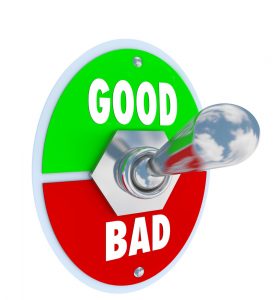
You will make mistakes and lose opportunities. Plans will fall apart. People will disappoint you, and occasionally you will disappoint yourself. There is no mindset powerful enough to eliminate those experiences, but there is a mindset powerful enough to keep them from being wasted.
You do not have to be thankful for every setback or pretend disappointment feels good. You certainly do not have to celebrate failure for failure’s sake. Just refuse to walk away from it empty-handed. Find the lesson. Accept the responsibility that belongs to you, adjust your approach, and try again with better information. Because some of the experiences we label as bad today may eventually become the very experiences that prepared us for something better tomorrow.
You cannot always turn a bad outcome into a good one, but with the right mindset, you can almost always turn it into something useful. And sometimes, that is exactly how future success begins.
Steve