
Steve Ferrante's High Performance Blog for Sales/Customer Service/Leadership Champs and Progressive Professionals!

Good Day Pinnacle Performers,

Welcome to May! Hope this post finds you doing extraordinarily well.

We have arrived at the last in the series of John Wooden Maxims:

“Things turn out best for the people who make the best of the way things turn out.”

Excerpt from Wooden: A Lifetime of Observations and Reflections on and Off the Court:

“Why is it so much easier to complain about the things we do not have than to make the most of and appreciate the things we do have?”

This quote ties directly into the Maxim as many folks don’t make the most of the way things turns out, instead focusing on and complaining about what is missing and/or wrong with the situation.

This is a lesson I personally lived out in my professional selling efforts. When I started in business management consulting sales, I was assigned a territory that was considered to be “saturated”, having gone through many years with many different sales reps before me calling on what was, by and large, the same prospective client base.  At the same time, there were brand new “virgin” territories in other areas of the Eastern U.S. that afforded the sales reps there opportunities to get in front of potential clients for the very first time. In a new territory, it was not uncommon for the salesperson who worked there to receive (from the company’s inside sales effort) twice the number of appointments in any given week.

It would have been quite easy to focus on those negatives; I can’t sell because the territory is saturated, I can’t sell because the prospects I’m seeing have seen us 14 times already,  I can’t sell because I’m getting half the appointments, etc.

Instead I chose (with some effective mentoring at the time) to focus on what I did have and could control. If I had less opportunities and the opportunities themselves would potentially be of lower quality, well then I needed to be all that much better with the opportunities I did have or I would surely fail.  I’m happy to report that was not the case…

Over my 10 years with the company, I maintained the highest batting average (sales to presentation ratio) and ended my tenure with the highest generated revenue totals in the company’s history.

One thing is certain. You will have challenges. You will have obstacles. In order to succeed you must build a mental bridge and get over them. What John Wooden said is true:

Thing Turn Out Best - John Wooden

Make a Great Day!

Steve 🙂

Sad Day Here in Boston Folks…

In the aftermath of the tragic Boston Marathon bombings there is a dark cloud lingering over the city as our community tries to make sense of what was a senseless, heartless, maddening act of violence. Certainly the thoughts and hearts of everyone in New England and throughout our U.S. of A go out to the victims and their families.  Personally, I hope those tasked with tracking down the attacker(s) are soon successful and justice is swift and the penalty severe.

If there’s a bright side to this shocking tragedy it is how the worst of times often bring out the best in many of us. That was certainly the case yesterday as Bostonians as well as countless individuals that had traveled in from out of the area for the marathon united for a common cause; to lend a hand and do what they could to help those in need.

Although it’s tough to make constructive comparisons to something so terrible, I was reminded yesterday of the connection to customer care. As I have written about, teach and preach to my clients, the true test of a business’ customer service fitness is not when things are going right but rather what is done when something goes wrong. Well something certainly went wrong yesterday.

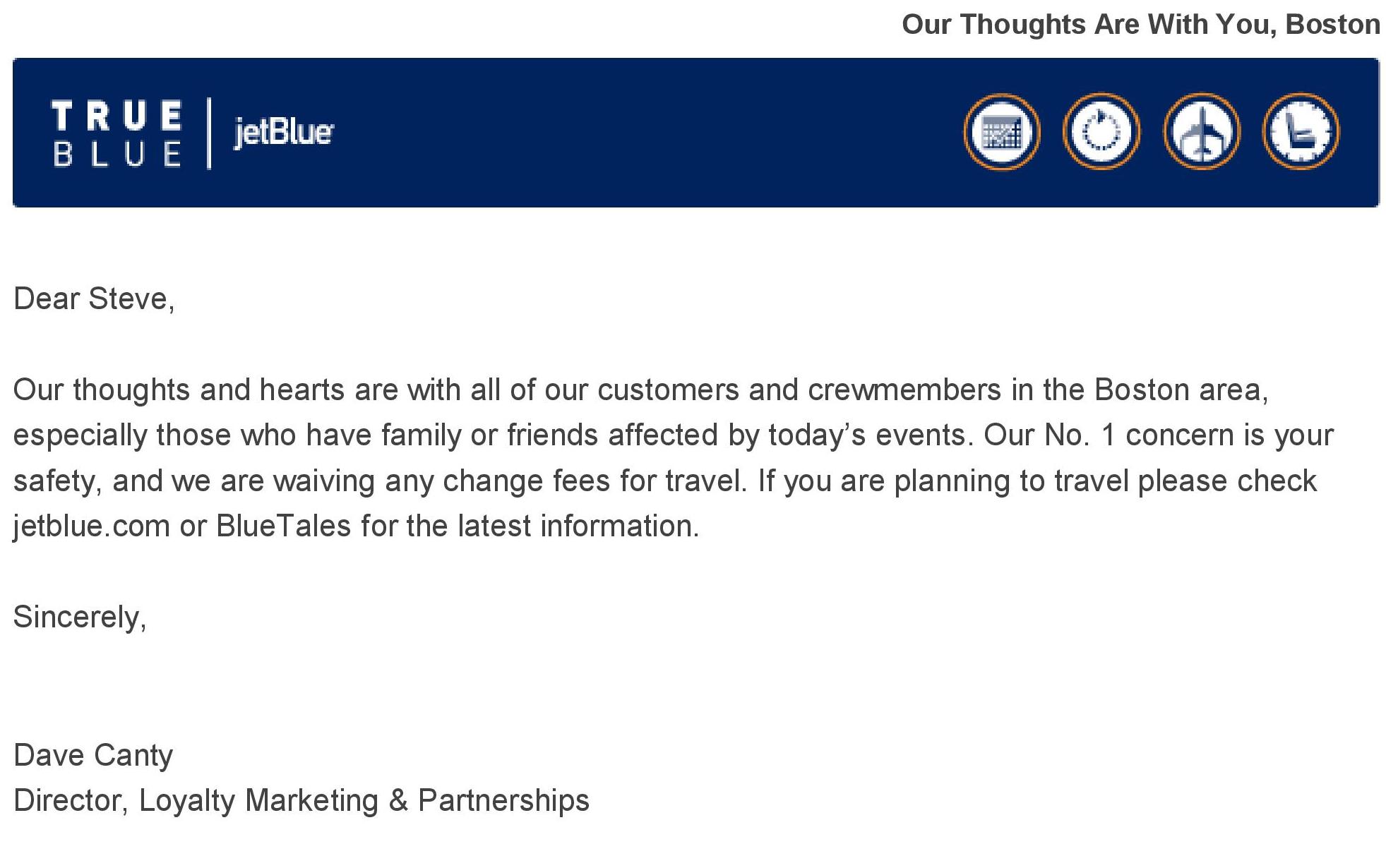
With that in mind, I received the following message via email yesterday from one of my favorite ‘Pinnacle Performance’ companies, JetBlue, yesterday:

Our Thoughts Are With You-page-001

While it’s doubtful that any of us in customer service (and we’re all in customer service in one way or another) will have to deal with anything approaching something as tragic as the attacks in Boston, all customers have needs and it is how we deal with these needs, the empathy we demonstrate and the customer care we execute that makes all the difference. 

Wishing You Well

Steve

http://www.linkedin.com/in/steveferrantesaleawayllc/

Good Day Pinnacle Performers,

Time marches on and with it we have arrived at the next John Wooden Maxim: It’s what you learn after you know it all that counts.

Wooden On Learning

This popular Wooden maxim is the first quote I reference with new trainees. While select students are novice, inexperienced lads and ladies, most folks enter training with at least several years of experience, up to seasoned veterans with 10+ years on-the-job.

Many of these experienced folks enter new training with a know it all already mentality, seemingly close-minded to new ideas. Obviously this is not the most favorable attitude when it comes to learning anything.

Fortunately, the vast majority of participants in my Pinnacle Performance training do come around. Usually at some point during our first time together they realize they actually didn’t know this or that and, now that they do, they’re better for it.

“Always be learning, acquiring knowledge, and seeking wisdom with a sense that you are immortal and that you will need much knowledge and wisdom for that long journey ahead. Know that when you are through learning, you are through.” – John Wooden

The reality is you can’t learn anything if you already know everything.

You Can't Learn Anything, If You Already Know Everything

Those know it all types aren’t particularly interested in moving forward and growing, contending that if they don’t know it by now then they never will.

Pinnacle Performers maintain an open-mind and pro-actively seek out new learning opportunities and ideas that can help them further their skill set and performance.

Looking to learn more? Visit Steve’s Recommended Reading

Make a Great Day!

Steve

Good Day All,

As my Pinnacle Performance pupils well know, there are many elements that make up an effective “Winning Team” culture as I wrote about here > The Great Eight Practices for Creating a Winning Team Culture

Of these, the most important is effective leadership that leads by example, supports and manages effective team member behaviors, and drives morale and motivation.

For a reverse perspective, below is an excellent article from Jack and Suzy Welch that outlines six areas that work against effective leadership and impede the successful development of a winning team culture.

Make a Great Day!

Steve 🙂

The Six Deadly Sins of Leadership

By Jack and Suzy Welch

Being a leader is perhaps the hardest challenge any of us will ever face. No matter how long we work at it, practicing the right behaviors is a never-ending task. Knowing – and avoiding – the wrong ones is too. Thus, we offer the following six common leadership pitfalls:

1. Not Giving Self-Confidence its Due.

Self-confidence is the lifeblood of success. When people have it, they’re bold. They try new things, offer ideas, exude positive energy, and cooperate with their colleagues instead of surreptitiously attempting to bring them down. When they lack self-confidence, it’s just the opposite. People cower. They plod. And they spread negativity with every word and gesture.

But all too often leaders ignore (or neglect) this very basic fact of the human condition. Why is anyone’s guess. Perhaps they just don’t understand that it is part of their job to instill self-confidence in their people. It may even be said that it’s their first job. You cannot unleash the creative power of individuals who doubt themselves.

Fortunately, some people seem to be born with self-confidence. Others gain it from life and work experience and come to a company fully loaded. Regardless, leaders can never stop pouring self-confidence into their teams. The ways to do so are myriad. Make sure goals are challenging – but achievable. Give effusive positive feedback. Remind your direct reports of what they do right.

We’re not saying that leaders should blindly extol and exalt. People know when they’re being gamed. But good leaders work relentlessly to find ways to instill self-confidence in those around them. They know it’s the gift that never stops giving.

2. Muzzling Voice.

Perhaps the most frustrating way that leaders underperform is by over-talking. That is, they act like know-it-alls. They can tell you how the world works, what corporate is thinking, how it will backfire if you try this or that, and why you can’t possibly change the product one iota. Sometimes such blowhards get their swagger from a few positive experiences, but usually they’re just victims of their own destructive personalities.

Ultimately, the company ends up being a victim too, because know-it-alls aren’t just insufferable, they’re dangerous. They don’t listen, and that deafness makes it very hard for new ideas to get debated, expanded upon, or improved. No single person, no matter how smart, can take a business to its apex. For that, you need every voice to be heard.

3. Acting Phony.

Can you spot a phony? Of course you can – and so can your people. Indeed, if there is one widespread human capability, it is sniffing out someone who is putting on airs, pretending to be who they’re not, or just keeping their real self hidden. Yet too many leaders spend way too much time creating personas that put a wall between them and their employees. What a waste.

Because authenticity is what makes people love you. Visibly grappling with tough problems, sweating the details, laughing, and caring – those are the activities that make people respond and feel engaged with what you’re saying. Sure, some people will tell you that being mysterious grants you power as a leader. In reality, all it generates is fear. And who wants to motivate that way?

Now, obviously, authenticity is unattractive if it’s coupled with immaturity or an overdose of informality. And organizations generally don’t like people who are too emotionally unbounded – i.e. so real that all their feelings are exposed. They tend to tamp that kind of intensity down a bit. And that’s not a bad thing, as work is work and, more than at home, allows us to maintain some privacy.

But don’t let convention wring all the authenticity out of you, especially as you climb the ladder. In time, humanity always wins. Your team and bosses come to know who you are in your soul, what kind of people you attract and what kind of performance you want from everyone. Your realness will make you accessible; you will connect and you will inspire. You will lead.

4. Lacking the Guts to Differentiate.

You only have to be in business a few weeks to know that not all investment opportunities are created equal. But some leaders can’t face that reality, and so they sprinkle their resources like cheese on a pizza, a little bit everywhere.

As a result, promising growth opportunities too often don’t get the outsized infusions of cash and people they need. If they did, someone might get offended during the resource allocation process. Someone – as in the manager of a weak business or the sponsor of a dubious investment proposal.

But leaders who don’t differentiate do the most damage when it comes to people. Unwilling to deliver candid, rigorous performance reviews, they give every employee the same kind of bland, mushy, “nice job” sign-off. Then, when rewards are doled out, they give star performers little more than the laggards. Now, you can call this egalitarian approach kind, or fair – as these lousy leaders usually do – but it’s really just weakness. And when it comes to building a thriving organization where people have the chance to grow and succeed, weakness just doesn’t cut it.


5. Fixation on Results at the Expense of Values.

Everyone knows that leaders deliver. Oratory and inspiration without results equal…well, a whole lot of nothing. But leaders are committing a real dereliction of duties if all they care about are the numbers. They also have to care about how those numbers came to be. Were the right behaviors practiced? Was the company’s culture of integrity honored? Were people taken care of properly? Was the law obeyed, in both letter and spirit?

Values are a funny thing in business. Companies love to talk about them. They love to hang them up on plaques in the lobby and boast about them to potential hires and customers. But they’re meaningless if leaders don’t live and breathe them. Sometimes that can take courage. It can mean letting go of a top performer who’s a brute to his colleagues, or not promoting a star who doesn’t share her best ideas with the team. That’s hard.

And yet if you’re a leader, this is a sin you cannot squint away. When you nail your results, make sure you can also report back to a crowded room: We did this the right way, according to our values.

6. Skipping the Fun Part

What is it about celebrating that makes managers so nervous? Maybe throwing a party doesn’t seem professional, or it makes people worry that they won’t look serious to the powers that be, or that, if things get too happy in the office, people will stop working their tails off.

Whatever the reason, too many leaders don’t celebrate enough. To be clear here, we do not define celebrating as conducting one of those stilted little company-orchestrated events that everyone hates, in which the whole team is marched out to a local restaurant for an evening of forced merriment when they’d rather be home. We’re talking about sending a team to Disney World with their families, or giving each team member tickets to a show or a movie, or handing each member of the team a new iPod.

What a lost opportunity. Celebrating makes people feel like winners and creates an atmosphere of recognition and positive energy. Imagine a team winning the World Series without champagne spraying everywhere. You can’t! And yet companies win all the time and let it go without so much as a high-five.

Work is too much a part of life not to recognize the moments of achievement. Grab as many as you can. Make a big deal out of them.

That’s part of a leader’s job too – the fun part.

This content was originally presented as a lecture at the Jack Welch Management Institute.

Jack Welch is Founder and Distinguished Professor at the Jack Welch Management Institute at Strayer University.

Suzy Welch is a best-selling author, popular television commentator, and noted business journalist. 

Together, Jack and Suzy Welch co-authored the international bestseller Winning. 


Good Day Pinnacle Performers,

This next John Wooden MAXIM is one of the best of his best.

Never Mistake Activity For Achievement

Over my 25+ years in sales/sales management and sales/customer service training, I have witnessed countless sales and customer service people that confuse activity with achievement, many on a daily basis.

The fact is many sales and customer service people routinely engage in activities that keep them busy rather than focusing their efforts and attention on the behaviors that will move them forward towards greater success. They perform their going through the motions routine and have the outward appearance of  lots going on but, like running on the treadmill, tomorrow they’re no father along then they are today.

It reminds me of the wonder years coaching my kids soccer teams. During games, everyone would run around (lots of activity) but hardly anyone would score (achievement). At the end of the game everyone would feel like they worked their butts off and accomplished something but the score would reflect otherwise.

When you improve a little each day, eventually big things occur…. Not tomorrow, not the next day, but eventually a big gain is made. Don’t look for the big, quick improvement. Seek the small improvement one day at a time. That’s the only way it happens — and when it happens, it lasts. — John Wooden

This MAXIM ties in perfectly with the previously posted Ben Franklin Lesson 3: Stop Procrastinating! where I wrote about Managing Your Cash Flow Zone and the the difference between high-value and low-value activities

As I often say in training, there’s a difference between activity and prosperity. What will you do today to prosper tomorrow?

Make a Great Day!

Steve 🙂

Good Day Pinnacle Performers,

This next John Wooden Maxim ties in perfectly to one of the principles I preach and teach to my Pinnacle Performance clients; Focus On What You Can Control.

Excerpt from Wooden: A Lifetime of Observations and Reflections on and Off the Court:

When you get too engrossed in those things over which you have no control, it will adversely affect those things over which you do have control – namely, your preparation.

All too often, individuals get bogged down by things that are beyond their control. High-achiever Pinnacle Performers do not allow themselves to become a victim of competition, market circumstances, pricing or other external issues they cannot control that would otherwise undermine their productivity and results.

The reality of sales is you cannot manage your results. You can only manage (control) what you do to achieve those results.

You must be well-prepared, maintain the proper positive attitude, focus on your behaviors (Doing the right things) and your execution (doing the right things the right way).

By focusing on the things you can do you are maximizing your time and best positioning yourself to succeed!

Do Not Let What You Cannot Do Interfere With What You Can Do

Make a Great Day!

Steve 🙂

Got PRIDE?

P.R.I.D.E. is an acronym for Personal Responsibility In Delivering Excellence!

The-quality-of-a-persons-life

My Pinnacle Performance sales, customer service and winning team culture training is driven by research of world-class organizations; market leaders, customer service champs and many companies that are also considered to be the best places to work in the world. What did these businesses do to achieve their market superiority? What are the best practices and principles that guide and motivate their culture, engage and influence their customers, and deliver high-performance results? And, most importantly, how do you apply these winning elements in your organization?

As I pinball around North America training organizations on Pinnacle Performance we learn (and work to adopt and institutionalize) the answers to those questions. Answers that would take far more time than we have here and now.

However, there is something you can (and very much should) do now that will have a substantial positive impact on your organizations performance. That’s something is practicing PRIDE in all that your organization does.

I want to be clear here… Most executives already believe they have PRIDE. If you’re an owner or senior manager then it’s safe to say that you’re likely committed to delivering excellence in your organization. That’s not the problem.

The problem is that results for an organization are rarely the result of the senior executives efforts alone. By and large results originate from the employees that meet, greet and interact with customers (and potential customers) at the point-of-sale.  It is here that PRIDE is most vulnerable and often falters.

Let me give you an example… One of the companies I cover in training is a leading gourmet retailer. I’m intentionally leaving out their name here but they are a very popular, recognizable brand that most likely has a store location a short distance from where you are now. Their sales/customer service model for employees is a fairly straightforward 3 principles: Connect, Discover, Respond. This is how employees are trained and what they should be doing on a customer-by-customer basis to deliver the best results for the customer and, ultimately, the business.

The reality is that this model, and every other training model, only works when the employees that need to carry it out have true PRIDE. When I teach about the gourmet retailer, countless trainees think or say “I’ve been there… that didn’t happen to me”. That is true and the answer as to why often goes back to the employees lack of PRIDE.

Doesn’t training teach PRIDE? Good question.. In short, no. As the first letter implies, PRIDE is something personal. It is fostered by effective leadership and enriched by a winning team culture environment and should certainly be reinforced in training.

Here’s another example…

A popular restaurant chain (again, leaving name out intentionally) with locations through-out North America trains their staff that when greeting a party seated at their table they should 1) squat down to eye level or sit at table if a seat is available and 2) ask if guests have eaten at the restaurant before so they can welcome appropriately. I have likely personally dined at this establishment over 50 times in the past 10 years alone and have only seen this simple 2-step act maybe 1/3 of the time. I’d bet that percentage is pretty accurate for all guest greetings across the chain. Again, ALL staff is trained that way, not 1/3. The simple answer for the discrepancy is PRIDE. Many employees that attend training (and ultimately work for a business) are tourists, they’re just along for the ride and really don’t care what the company wants. The most important thing to these disengaged folks when they attend training is “what time is lunch?” and “when do we get out of here?”  

Your organization may be preaching and teaching world-class practices and principles but if the employees are simply going through the motions and don’t buy-in and commit to practicing PRIDE then results will suffer.

PRIDE is the executable of Pinnacle Performance. To maximize results, all employees must practice PRIDE every day in all customer interactions. 

Show Your PRIDE! Print this poster and display where your team can see it daily > Champions PRIDE Poster

Make a Great Day!

Steve 🙂

Steve Ferrante is the CEO & Trainer of Champions of Sale Away LLC., providing Pinnacle Performance Sales, Customer Service and Winning Team Culture training, speaking and professional development services to success-driven businesses throughout North America. For more information on Steve and Pinnacle Performance services visit saleawayllc.com. Steve can be reached @ steve@saleawayllc.com

Be Quick, But Don’t Hurry

Good Day Pinnacle Performers,

Let’s kick-off the week on a high-note with the next John Wooden Maxim; Be Quick, But Don’t Hurry.

Excerpt from Wooden: A Lifetime of Observations and Reflections on and Off the Court:

“When you hurry you tend to make mistakes.  On the other hand, if you can’t execute quickly, you may be too late to accomplish your task. It’s a delicate but crucial balance.”

This little maxim has big meaning when it comes to maximizing your performance. Customers want you to be pro-active and “act quickly” to address their needs. They also want personal care and attention and, if you hurry this area, they won’t feel your behavior was sincere and you put the relationship at risk.

World class customer service pro’s maintain proper balance; quick in service but slow in interactions with customers. So, like a supercar, you must be “Quick” and responsive when needed and also properly paced “Don’t Hurry” when called for.

Wooden Be Quick But Don't Hurry

Walk The Path!

Steve 🙂

Good Day Pinnacle Performers,

Here’s your first inspirational maxim from John Wooden, The Greatest Coach.

“Make Each Day Your Masterpiece” is all about the here and now. You only get one shot at maximizing today for tomorrow it’s gone.

John Wooden taught his players to do the best you can each and every day. What you do (or don’t do) to prepare and improve today will shape and create your future success (or lack thereof).

Excerpt from the great book, Wooden: A Lifetime of Observations and Reflections on and Off the Court:

“Too often we get distracted by what is outside our control. You can’t do anything about yesterday. The door to the past has been shut and the key thrown away. You can do nothing about tomorrow. It is yet to come. However, tomorrow is in large part determined by what you do today. So make today a masterpiece. You have control over that.”

This ties very well into the Pinnacle Performance principle I cover in client training: Small changes over a consistent period of time equal BIG results. By applying yourself to be a little better in your behaviors and execution each day, you will become a lot better over time.

It starts today…

Make Masterpiece Wooden

Make a Great Day!

Steve 🙂

disservice

There’s a lot of talk about the importance of providing quality customer service and superior customer experiences to improve customer loyalty and sales and, as you know if you’ve visited this blog before, these topics are a primary elements of my Pinnacle Performance training seminars and consulting practices. But, on the flip side, there’s relatively little dialogue about the aspects that turn customers off, harm customer relationships, and can ultimately have customers not only leave your business for a competitor but do so while complaining about your business to everyone they come into contact with.

Please allow me to provide you a very personal experience of my recent family vacation in sunny San Diego. I didn’t know it (or expect it) going in but left with plenty of examples of what not to do when providing proper customer service. First, please know I am removing the destination name we stayed at because this is not intended to slam them directly but rather to learn from their mistakes and ensure you’re not doing the same with your customers.

The first thing you should know is that this was not a bargain basement motor lodge. It is a high-end, “luxury resort” that advertises “first class” vacation experiences. Sounds wonderful… let’s go!

Traveling with another family, we required two separate suites. Using a special American Express promotion I was able to secure a desirable “free room upgrade”, a significant savings of $50 dollars per night over paying for the rooms without the AMEX card. On the online reservation return receipt I noticed that room upgrades (like the ones I just reserved) are “based on availability” so I promptly called the hotel for clarification and was told to call back a week before traveling out and they would reserve the room upgrades at that time.

Enter Patsy. Patsy and I had a wonderful conversation and she was most helpful saying that my room upgrades were “all set” and would be waiting for us when we got there. So we got there and, lo and behold, found that was only half true. Seems only 1 room upgrade is available, the other is not. Not particularly good news and certainly not what we were expecting. I explained my previous “all set” call with Patsy. The reply from the front desk employee? “Patsy is in reservations, she doesn’t upgrade rooms”. Let me see if I have this straight… Patsy is in reservations and she doesn’t manage reservations? You would think the person most empowered to manage reservations would be the person whose job is to interact with customers on their reservations line, right? Evidently, wrong. So much for being “all set”.

Lesson #1: Be Accountable.

A big part of delivering great customer service is assuming responsibility and standing behind your commitments. Saying it is not the important part. Doing it is. Sales and service professionals already have their work cut out for them to gain customers trust. Broken commitments are a warning sign of mistrust that can seriously jeopardize the health of the relationship. You will never see this type “it’s not her job” finger pointing at elite customer service establishments. They focus on making it right for the external customer not on who made it wrong internally.

Once settled in our suite we realized there was no silverware, glasses, plates or any other kitchen utensil in our kitchen. So we called the front desk. Remarkably, their first response was “many guests bring these household items with them”. We traveled across the country from Boston to San Diego with two kids and four suitcases. Did they actually expect us to pack and lug our kitchen items as well?

Lesson # 2: Never make your customer feel like they did something wrong.

 When a customer feels like their being accused of wrong doing they typically get defensive, annoyed and uncomfortable. Obviously, these are not the best emotions for positive customer relations. Never make the issue the issue, focus instead on what you can do to help the customer. Managed properly, the front desk employee should have replied with something like, “I’m sorry to hear that, we should have asked you upon reservation if you would like us to supply the kitchen with these items, I’ll see to it that this gets taken care of right away.”

In any event, after the initial inquiry nothing happened so a few hours later we called again. Each time the staff member on the other end of the line was polite, helpful sounding and ensured us it would be taken care of in short order. But, for the entire day, exactly nothing materialized and we were still completely utensil-less. So the next morning while staring at our dry cereal we decided to physically go to the front desk and seek redemption. Once again, the smiling staff member entered the information into “the system” and ensured us that the utensils would be sent over right away. A few hours later when (unbelievably) no one showed up I made the last call, the call that makes it clear that we are beyond displeased, have no faith in anything that is spoken to us, and asked what manager I should speak with when nothing happens after this call-in-progress too. That’s all it took to get some basic kitchen utensils at this “luxury resort”.

Lesson # 3: It’s not what you say, it’s what you do.

 The old adage is true; actions do speak louder than words. Many people think providing great customer service is about being friendly, polite and smiling a lot. While that’s essential it is only part of the total equation. You can smile all day but if you don’t fulfill your commitments and meet your customers’ expectations then the net effect is greatly diminished. Customers ultimately view the gestures as insincere, and you’ll end up with an unhappy customer.

Unfortunately, we experienced at least a couple more incidents of customer disservice that week. Clearly, there is a detrimental disconnect between what staff members are demonstrating/saying (behaviors) and what they’re doing (actions/execution) at this vacation resort. True world-class customer service can only be achieved with a proper unity between the two.

In closing, always remember this fitting Ben Franklin quote, “Well done is better than well said.”

Steve 🙂

Tag Cloud