Steve Ferrante's High Performance Blog for Sales/Customer Service/Leadership Champs and Progressive Professionals!

Posts tagged ‘Steve Ferrante’

Got PRIDE?

P.R.I.D.E. is an acronym for Personal Responsibility In Delivering Excellence!

The-quality-of-a-persons-life

My Pinnacle Performance sales, customer service and winning team culture training is driven by research of world-class organizations; market leaders, customer service champs and many companies that are also considered to be the best places to work in the world. What did these businesses do to achieve their market superiority? What are the best practices and principles that guide and motivate their culture, engage and influence their customers, and deliver high-performance results? And, most importantly, how do you apply these winning elements in your organization?

As I pinball around North America training organizations on Pinnacle Performance we learn (and work to adopt and institutionalize) the answers to those questions. Answers that would take far more time than we have here and now.

However, there is something you can (and very much should) do now that will have a substantial positive impact on your organizations performance. That’s something is practicing PRIDE in all that your organization does.

I want to be clear here… Most executives already believe they have PRIDE. If you’re an owner or senior manager then it’s safe to say that you’re likely committed to delivering excellence in your organization. That’s not the problem.

The problem is that results for an organization are rarely the result of the senior executives efforts alone. By and large results originate from the employees that meet, greet and interact with customers (and potential customers) at the point-of-sale.  It is here that PRIDE is most vulnerable and often falters.

Let me give you an example… One of the companies I cover in training is a leading gourmet retailer. I’m intentionally leaving out their name here but they are a very popular, recognizable brand that most likely has a store location a short distance from where you are now. Their sales/customer service model for employees is a fairly straightforward 3 principles: Connect, Discover, Respond. This is how employees are trained and what they should be doing on a customer-by-customer basis to deliver the best results for the customer and, ultimately, the business.

The reality is that this model, and every other training model, only works when the employees that need to carry it out have true PRIDE. When I teach about the gourmet retailer, countless trainees think or say “I’ve been there… that didn’t happen to me”. That is true and the answer as to why often goes back to the employees lack of PRIDE.

Doesn’t training teach PRIDE? Good question.. In short, no. As the first letter implies, PRIDE is something personal. It is fostered by effective leadership and enriched by a winning team culture environment and should certainly be reinforced in training.

Here’s another example…

A popular restaurant chain (again, leaving name out intentionally) with locations through-out North America trains their staff that when greeting a party seated at their table they should 1) squat down to eye level or sit at table if a seat is available and 2) ask if guests have eaten at the restaurant before so they can welcome appropriately. I have likely personally dined at this establishment over 50 times in the past 10 years alone and have only seen this simple 2-step act maybe 1/3 of the time. I’d bet that percentage is pretty accurate for all guest greetings across the chain. Again, ALL staff is trained that way, not 1/3. The simple answer for the discrepancy is PRIDE. Many employees that attend training (and ultimately work for a business) are tourists, they’re just along for the ride and really don’t care what the company wants. The most important thing to these disengaged folks when they attend training is “what time is lunch?” and “when do we get out of here?”  

Your organization may be preaching and teaching world-class practices and principles but if the employees are simply going through the motions and don’t buy-in and commit to practicing PRIDE then results will suffer.

PRIDE is the executable of Pinnacle Performance. To maximize results, all employees must practice PRIDE every day in all customer interactions. 

Show Your PRIDE! Print this poster and display where your team can see it daily > Champions PRIDE Poster

Make a Great Day!

Steve 🙂

Steve Ferrante is the CEO & Trainer of Champions of Sale Away LLC., providing Pinnacle Performance Sales, Customer Service and Winning Team Culture training, speaking and professional development services to success-driven businesses throughout North America. For more information on Steve and Pinnacle Performance services visit saleawayllc.com. Steve can be reached @ steve@saleawayllc.com
Be Quick, But Don’t Hurry

Good Day Pinnacle Performers,

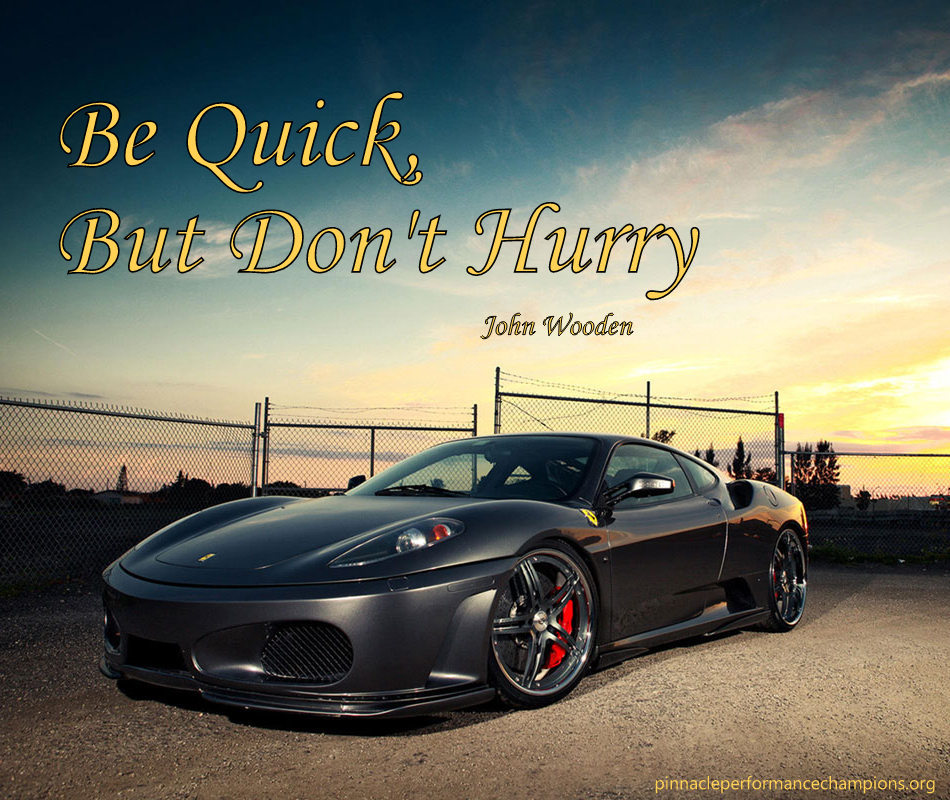
Let’s kick-off the week on a high-note with the next John Wooden Maxim; Be Quick, But Don’t Hurry.

Excerpt from Wooden: A Lifetime of Observations and Reflections on and Off the Court:

“When you hurry you tend to make mistakes.  On the other hand, if you can’t execute quickly, you may be too late to accomplish your task. It’s a delicate but crucial balance.”

This little maxim has big meaning when it comes to maximizing your performance. Customers want you to be pro-active and “act quickly” to address their needs. They also want personal care and attention and, if you hurry this area, they won’t feel your behavior was sincere and you put the relationship at risk.

World class customer service pro’s maintain proper balance; quick in service but slow in interactions with customers. So, like a supercar, you must be “Quick” and responsive when needed and also properly paced “Don’t Hurry” when called for.

Wooden Be Quick But Don't Hurry

Walk The Path!

Steve 🙂

Customer Disservice… With a Smile!

disservice

There’s a lot of talk about the importance of providing quality customer service and superior customer experiences to improve customer loyalty and sales and, as you know if you’ve visited this blog before, these topics are a primary elements of my Pinnacle Performance training seminars and consulting practices. But, on the flip side, there’s relatively little dialogue about the aspects that turn customers off, harm customer relationships, and can ultimately have customers not only leave your business for a competitor but do so while complaining about your business to everyone they come into contact with.

Please allow me to provide you a very personal experience of my recent family vacation in sunny San Diego. I didn’t know it (or expect it) going in but left with plenty of examples of what not to do when providing proper customer service. First, please know I am removing the destination name we stayed at because this is not intended to slam them directly but rather to learn from their mistakes and ensure you’re not doing the same with your customers.

The first thing you should know is that this was not a bargain basement motor lodge. It is a high-end, “luxury resort” that advertises “first class” vacation experiences. Sounds wonderful… let’s go!

Traveling with another family, we required two separate suites. Using a special American Express promotion I was able to secure a desirable “free room upgrade”, a significant savings of $50 dollars per night over paying for the rooms without the AMEX card. On the online reservation return receipt I noticed that room upgrades (like the ones I just reserved) are “based on availability” so I promptly called the hotel for clarification and was told to call back a week before traveling out and they would reserve the room upgrades at that time.

Enter Patsy. Patsy and I had a wonderful conversation and she was most helpful saying that my room upgrades were “all set” and would be waiting for us when we got there. So we got there and, lo and behold, found that was only half true. Seems only 1 room upgrade is available, the other is not. Not particularly good news and certainly not what we were expecting. I explained my previous “all set” call with Patsy. The reply from the front desk employee? “Patsy is in reservations, she doesn’t upgrade rooms”. Let me see if I have this straight… Patsy is in reservations and she doesn’t manage reservations? You would think the person most empowered to manage reservations would be the person whose job is to interact with customers on their reservations line, right? Evidently, wrong. So much for being “all set”.

Lesson #1: Be Accountable.

A big part of delivering great customer service is assuming responsibility and standing behind your commitments. Saying it is not the important part. Doing it is. Sales and service professionals already have their work cut out for them to gain customers trust. Broken commitments are a warning sign of mistrust that can seriously jeopardize the health of the relationship. You will never see this type “it’s not her job” finger pointing at elite customer service establishments. They focus on making it right for the external customer not on who made it wrong internally.

Once settled in our suite we realized there was no silverware, glasses, plates or any other kitchen utensil in our kitchen. So we called the front desk. Remarkably, their first response was “many guests bring these household items with them”. We traveled across the country from Boston to San Diego with two kids and four suitcases. Did they actually expect us to pack and lug our kitchen items as well?

Lesson # 2: Never make your customer feel like they did something wrong.

 When a customer feels like their being accused of wrong doing they typically get defensive, annoyed and uncomfortable. Obviously, these are not the best emotions for positive customer relations. Never make the issue the issue, focus instead on what you can do to help the customer. Managed properly, the front desk employee should have replied with something like, “I’m sorry to hear that, we should have asked you upon reservation if you would like us to supply the kitchen with these items, I’ll see to it that this gets taken care of right away.”

In any event, after the initial inquiry nothing happened so a few hours later we called again. Each time the staff member on the other end of the line was polite, helpful sounding and ensured us it would be taken care of in short order. But, for the entire day, exactly nothing materialized and we were still completely utensil-less. So the next morning while staring at our dry cereal we decided to physically go to the front desk and seek redemption. Once again, the smiling staff member entered the information into “the system” and ensured us that the utensils would be sent over right away. A few hours later when (unbelievably) no one showed up I made the last call, the call that makes it clear that we are beyond displeased, have no faith in anything that is spoken to us, and asked what manager I should speak with when nothing happens after this call-in-progress too. That’s all it took to get some basic kitchen utensils at this “luxury resort”.

Lesson # 3: It’s not what you say, it’s what you do.

 The old adage is true; actions do speak louder than words. Many people think providing great customer service is about being friendly, polite and smiling a lot. While that’s essential it is only part of the total equation. You can smile all day but if you don’t fulfill your commitments and meet your customers’ expectations then the net effect is greatly diminished. Customers ultimately view the gestures as insincere, and you’ll end up with an unhappy customer.

Unfortunately, we experienced at least a couple more incidents of customer disservice that week. Clearly, there is a detrimental disconnect between what staff members are demonstrating/saying (behaviors) and what they’re doing (actions/execution) at this vacation resort. True world-class customer service can only be achieved with a proper unity between the two.

In closing, always remember this fitting Ben Franklin quote, “Well done is better than well said.”

Steve 🙂

Success Lessons From Zig

Good Day & Happy Holiday Season All,

As you may know, famed motivational speaker, author and man with the coolest name in the biz, Zig Ziglar, died on November 28th at the age of 86.

Over five decades, Ziglar authored more than two dozen books on salesmanship and personal ‘self-help’ development, emphasizing that success is dependent mainly on ones attitude and motivation, rather than educational aptitude or salesy schmoozing ability.

Regarded as one of the best motivational speakers of our time, Zig would regularly pack arenas to share his message of positive attitude, motivation and success through stories highlighted with short quotes that have become like commandments for success with his legions of followers.

Below are my favorite lessons from Zig that apply directly to my Pinnacle Performance teachings:

You Have To Start To Be Great

Zig - Start To Be Great

Expect The Best

Zig - Expect The Best

Your Attitude Determines Your Altitude

Zig - Attitude Not Aptitude

People Buy Emotionally

Zig - People Buy Emotionally

Be a Friend First

Zig - Be a friend

Motivate Daily

Zig - Motivation Daily

Help Others To Help Yourself

Zig - All You Want In Life

Make A Great Day!

Steve 🙂

More > Misc Brain Food

See All > Pinnacle Performance Quotes on Pinterest

Applying Stephen Covey’s Seven Habits of Highly Effective People for Pinnacle Performance

Hi All,

As you may know, Stephen Covey, author of “The Seven Habits of Highly Effective People” and three other self-help books that have all sold more than a million copies each, died today of complications from a bicycle accident in April.

One of my personal favorite personal development authors, Mr. Covey’s taught invaluable lessons and principles that have inspired me and countless others to improve both their professional and personal lives.

The following is an article I wrote that is based on the relation of champion performers and Covey’s most popular work, The Seven Habits of Highly Effective People.

Applying Stephen Covey’s Seven Habits of Highly Effective People for Pinnacle Performance

Stephen Covey’s Seven Habits of Highly Effective People are a simple set of rules for life – powerful principles anyone can apply to improve their personal productivity and performance.

In this article, we’ll overview each of the habits and how they apply to achieving Pinnacle Performance as a sales or customer service professional.

Habit 1:     Be Proactive ®

Covey states that this habit is the ability to control one’s environment, rather than have it control you, as is so often the case. This habit is in perfect harmony with one of my Pinnacle Performance Essential Elements of Extraordinary Service, “Responsiveness”. This element affirms that customers want their needs met with speed and purpose and service providers that take initiative and are proactive to their needs rather than them having to ask for assistance.

Habit 2:     Begin With The End In Mind ®

Covey describes this as the habit of personal leadership, the ability to lead oneself towards desired goals. In a meaningful way, this habit really is the foundation of my Pinnacle Performance teachings with focus on market-leading ‘world-class’ businesses and performers and how to apply their winning best practices and principles to individual efforts and the organization as a whole. In a nutshell, a sure path to achieving world-class performance is to begin with what world-class performance is, how it got that way, and then use that model to guide personal behaviors and those in your own organization.

Habit 3:     Put First Things First ®

Covey states that this is the habit of personal management and organizing and implementing activities in line with the goals established in habit 2.  This habit represents the execution elements of Pinnacle Performance. Too often sales and service personnel go through the motions and don’t follow any real process. Successful organizations and individuals recognize that success has a code and that by maintaining adherence to proven processes they can achieve their performance goals.

Habit 4:     Think Win-Win ®

This Covey habit is based on the principle that success is a natural extension of a co-operative ‘win-win’ approach over that of confrontational win-or-lose mindset. I see this all the time in sales organizations… Personnel try so hard to sell, to ‘close the deal’, that they lose focus of the most important person in the business relationship – the customer. By focusing on helping customers solve their needs/wants we properly position ourselves as trusted advisors (rather than salespeople) and create sustainable win-win relationships.

Habit 5:     Seek First to Understand and then to be Understood ®

This is Covey’s habit of effective communication. My personal favorite, this principle goes hand-in-hand with Pinnacle Performance. A chief component of successful communication is the ability to actively listen to what is being said first before responding. Too often sales and service personnel do not seek first to understand and instead push their agenda and alienate potential customers. The Pinnacle Performance Therapeutic Selling model aligns with this habit by positioning personnel to behave as doctors and diagnose first, then prescribe.

Habit 6:     Synergize ®

Covey says this is the habit of creative co-operation, the principle that the whole is greater than the sum of its parts. This is the glue of the Pinnacle Performance ‘winning team’ culture framework. Pinnacle Performance organizations recognize the sum of collective knowledge is greater than individual wisdom and they encourage information sharing and an environment of open communication where employees are comfortable contributing their feedback and ideas to improve performance.

Habit 7:     Sharpen the Saw ®

According to Covey, this is the habit of self-renewal, enabling personal growth and development. This is the reason many sales/customer service trainings fail, organizations conduct a one-time training and don’t continue to sharpen the saw. This is the reason most individuals are not Pinnacle Performers. They attend a training session and don’t continue to sharpen the saw. To truly create world-class performance and lasting success, you must consistently sharpen the saw with a disciplined and committed training regimen and personal continuous improvement.

For a pdf version of this article, click-on here > Applying Stephen Covey’s 7 Habits for Pinnacle Performance

The 7 Habits are registered trademarks of Stephen Covey.

Workplace FUN Tips!

Why are so many market-leading companies also the best places to work? Because they know happiness matters and they create a culture of fun in the workplace that improves employee morale and productivity.

Here’s a amusing little video on some silly things you could do to have some fun in your workplace…

Make a Great Day!

Steve

Tag Cloud