Steve Ferrante's High Performance Blog for Sales/Customer Service/Leadership Champs and Progressive Professionals!

Chasing Your Red Baron

“Curse you, Red Baron!” Snoopy shouts (in thought balloons) from the top of his doghouse, scarf blowing in the wind, goggles locked in.

Day after day, mission after mission, Snoopy launches into the skies. And day after day, he gets shot down. Again. And again. And again.

But here’s the thing…

He never stops climbing back onto that doghouse.

Because for Snoopy, it’s not just about winning the battle.
It’s about showing up. It’s about chasing the impossible.
It’s about believing that this time, the outcome might be different… because he’s different.

More prepared. More focused. More determined.

That’s perseverance.
Not the absence of setbacks, but the refusal to be defined by them.

So, whether you’re chasing down your own Red Baron, or just trying to get through a tough week, be like Snoopy:

Strap in. Take flight. Try again.

One day, you’ll win the battle you’ve been fighting for so long.

Steve

I wanted to take a moment to share a small experience that left a big impression during our vacation at Sandals Grande St. Lucian last week.

As we did each morning, my wife and I made our way down to the main dining room for breakfast. Everything in the big buffet looked delicious, and the staff—as usual—were welcoming and cheerful. But when I lifted the lid on the scrambled egg tray, it was empty. Not a big deal—it was the typical busy morning, and the food turnover was understandably quick.

As I was walking out, I casually remarked to one of the team members that the scrambled egg tray was empty—not complaining, just making a passing comment so they were aware.

I planned to return in a few minutes to check if the tray was replenished but, before I could, that same team member appeared with a fresh plate of scrambled eggs, under a silver cover no less, delivered right to our table with a warm smile.

Exhibit A.

I was honestly taken aback—in the best way. I hadn’t made a request or expected anything. But the team member listened, took the initiative, and made the effort to make sure I didn’t miss what I was looking forward to.

It may seem like a small thing, but that one gesture spoke volumes about the level of care and attention the Sandals team puts into guest’s experience. The team member turned a turned a moment of inconvenience into a memorable moment of hospitality—and a reminder that excellence in customer service lies in the details.

Steve

In the 1950s, game shows weren’t just entertainment, they were cultural phenomena. And The $64,000 Question was the ultimate stage. Contestants were expected to be sharp, composed, and above all, brilliant under pressure. But for 28-year-old psychologist, Dr. Joyce Diane Brothers, the challenge was even steeper.

She wasn’t just stepping into the spotlight as a contestant. She was stepping into a world that didn’t expect her to win.

As a woman in a male-dominated arena, she faced skepticism from the start. Whispers of doubt followed her every round. Could she handle the pressure? Did she really know her stuff? The odds were stacked. But Dr. Joyce didn’t flinch.

She studied. She prepared. And when the questions came—one after another—she answered with clarity, grace, and unwavering confidence.

And then she won.

Dr. Joyce Diane Brothers became a household name not just because she conquered a game show, but because she shattered a narrative. She didn’t just take home $64,000—she took down the barrier that said “you can’t” and replaced it with “watch me.”

Pinnacle Perspective

Dr. Joyce’s story is more than history, it’s fuel.

Her victory reminds us what Pinnacle Performance looks like—it’s not just about knowledge or talent. It’s about resilience. Preparation. Belief. It’s about showing up when no one expects you to win and turning doubt into proof.

High-achievers carry that mindset into everything they do. Whether it’s breaking personal records, pushing beyond mental limits, or rewriting what’s possible in your career or craft—Pinnacle is where potential meets power.

Dr. Joyce proved them wrong not by being louder, but by being better. Stronger. Smarter.

This Is Your Moment

Maybe they’ve counted you out. Maybe you’ve been told you’re not ready, not capable, not enough.

Good.

Let that be the spark. Because like Dr. Joyce, you don’t need anyone’s permission to succeed. You just need confidence in your capability, courage to show up, and the determination to follow through. So…

Believe you can. Rewrite the story. Win.

Steve

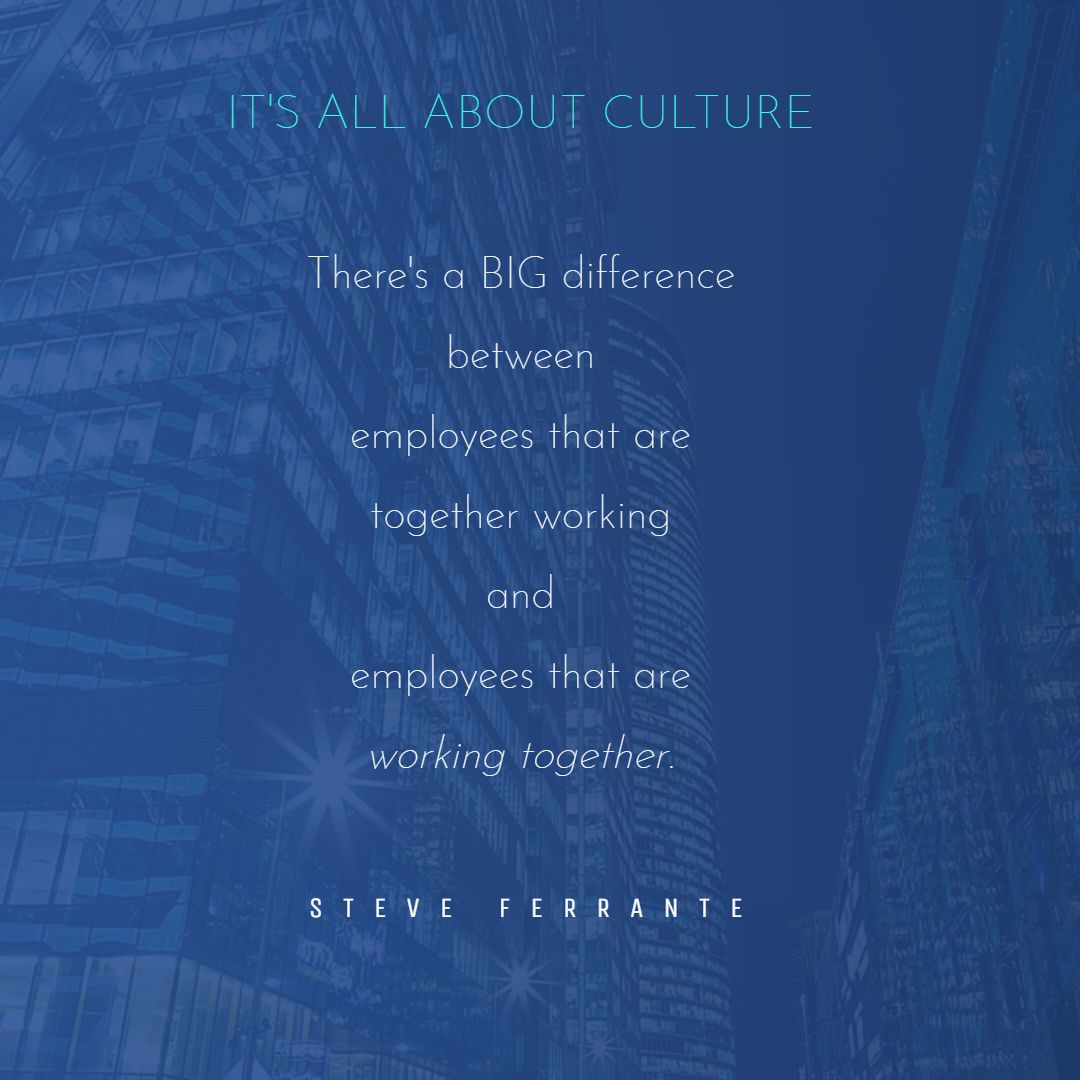
It’s All About Culture

Knowing the difference between ’𝘦𝘮𝘱𝘭𝘰𝘺𝘦𝘦𝘴 𝘵𝘩𝘢𝘵 𝘢𝘳𝘦 𝘵𝘰𝘨𝘦𝘵𝘩𝘦𝘳 𝘸𝘰𝘳𝘬𝘪𝘯𝘨 𝘢𝘯𝘥 𝘦𝘮𝘱𝘭𝘰𝘺𝘦𝘦𝘴 𝘵𝘩𝘢𝘵 𝘢𝘳𝘦 𝘸𝘰𝘳𝘬𝘪𝘯𝘨 𝘵𝘰𝘨𝘦𝘵𝘩𝘦𝘳’ can make all the difference in your organization:

“𝐓𝐨𝐠𝐞𝐭𝐡𝐞𝐫 𝐰𝐨𝐫𝐤𝐢𝐧𝐠”:

* Employees are merely present in the same space, performing their individual tasks.
* There is little to no synergy, shared vision, or collaboration.
* Employees function in silos, focused only on their own responsibilities.

“𝐖𝐨𝐫𝐤𝐢𝐧𝐠 𝐭𝐨𝐠𝐞𝐭𝐡𝐞𝐫”:

* There is unity and teamwork, employees actively collaborate to achieve common goals.
* An environment of support, shared accountability, and collective problem-solving.
* Employees are aligned and engaged, leveraging each other’s strengths to enhance outcomes.

A workplace culture where employees are genuinely collaborating drives higher productivity, stronger relationships, and better results for the organization. ‘Working together’ is a call to leaders to build a culture that encourages connection and shared purpose rather than simply sharing the same space.

Steve

The occasion of Thanksgiving gives us the opportunity to be thankful for what we have but being grateful should not be limited to the fourth Thursday in November.

From a business perspective, practicing an attitude of gratitude means letting customers know how much you value and appreciate their business.

Since starting Sale Away 19 years ago this month, I have asked thousands of sales and customer service associates in many dozens of businesses all over North America if they appreciate their customers and, predictably, I always receive the same response; “Of course we do!” Then I ask them the real question… How do your customers know?

The sad reality is quite often customers really don’t know or, more importantly, feel appreciated. Often, employees assume customers know they’re appreciated because they regularly thank them at the end of a given interaction. That’s great but true displays of customer appreciation are about much more than a token of “Thanks” at the end of interactions, they are heartfelt and consistent throughout the relationship.

Your customers (and potential customers) should always feel that you genuinely care for their personal well-being. This begins with treating them like human-beings and being grateful, not just because they’re interested in your products or services, but rather for the relationship and opportunity to help them.

Cultivate the habit of being grateful for every good thing that comes to you, and to give thanks continuously. And because all things have contributed to your advancement, you should include all things in your gratitude. ― Ralph Waldo Emerson

Although Thanksgiving is the time of year this sentiment is most talked about and expressed in others, sincere gratitude is not a seasonal affair. Your attitude of gratitude should be practiced year-round for there is much to be thankful for.

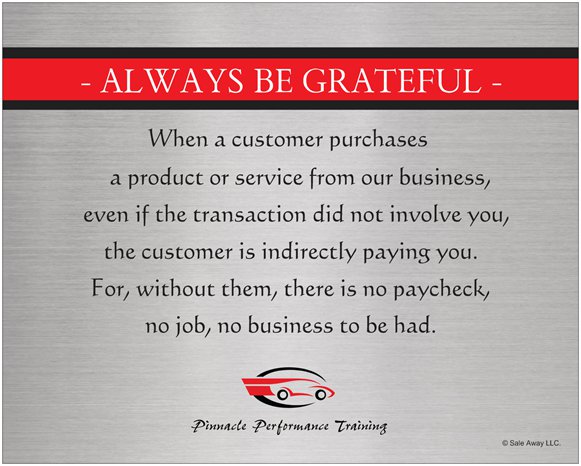
Always keep in mind (and heart) that when a customer purchases a product or service from your business, even if the transaction did not involve you, the customer is indirectly paying you. For, without them, there is no paycheck – no job – no business to be had.

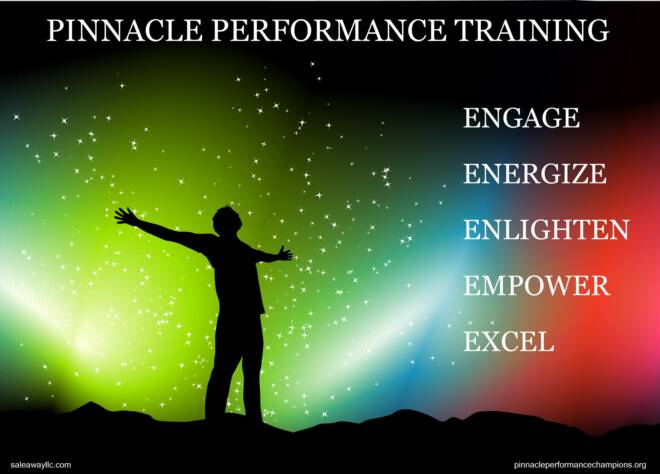
As the title of my Pinnacle Performance Training poster below reads… Always Be Grateful.

Maintain and Attitude of Gratitude

It is human nature that as we settle in over time, we “get used to” everything. When the company, your fellow team members, and customers become part of your daily routine it’s easy to lose the appreciation we had when these ‘good things’ were new to us. 

Of course, we don’t want to lose these things (our job, customers, etc.) to come to our senses and appreciate just how important they are! 

In order to not lose our sense of appreciation as new things become familiar to us, we must live in the moment and maintain an attitude of gratitude. This is easier said (or written about) than done. It takes a conscious effort where we mentally count our blessings and don’t allow ourselves to take the most important ‘good things’ for granted.

On the job, this takes true customer-focus.  You must not become complacent and go through the motions but rather execute with purpose and sincerity.

Of course, it’s not only what you say but what you do that makes the difference. Spontaneous “Thank You for Your Business” cards, follow-up calls to thank customers for their business and ensure they’re happy after the sale, random acts of kindness and consistent acts of exceptional service go a long way towards demonstrating genuine appreciation and gratitude.

Speaking of gratitude, I would be remiss if I didn’t Thank You for making it all the way to the end of this article. I appreciate your time and wish you all the best for success!

Steve

High-achievers in business and Olympic athletes share remarkable commonalities that drive their success. Despite their different arenas, both groups exhibit traits and behaviors that pave the way for extraordinary accomplishments.

Detailed below are my top three similarities between high-achievers and Olympic athletes. These fundamental traits drive extraordinary accomplishments and, by embracing these principles, individuals in any field can aspire to achieve greatness!

  1. Unyielding Discipline

Discipline is the backbone of success for both high-achievers and Olympic athletes. In the corporate world, high-achievers typically maintain a strict schedule, balancing meetings, strategy sessions, and continuous learning. They understand that consistency in their daily routines is crucial for long-term success.

Similarly, Olympic athletes follow rigorous training regimens, often starting their days before dawn to perfect their skills and build endurance. Whether it’s a sales executive preparing for a major presentation or an athlete training for a competition, the discipline they demonstrate is the foundation for their achievements.

  1. Resilience and Adaptability

Resilience is a defining trait that both high-achievers and Olympic athletes possess in abundance. The path to success is rarely linear, and setbacks are inevitable. High-achievers face challenges such as failed projects, market downturns, and strategic missteps. Instead of being deterred, they adapt, learn from their experiences, and pivot towards new opportunities.

Olympic athletes, too, encounter injuries, losses, and intense competition. Their ability to recover, adjust their training, and maintain focus on their goals exemplifies resilience. Both groups demonstrate that the ability to bounce back from adversity is crucial for reaching the pinnacle of their fields.

  1. Clear Goal Setting and Vision

Both high-achievers and Olympic athletes excel in setting and pursuing clear, ambitious goals. High-achievers define their career objectives with precision, creating actionable plans to achieve them. They visualize their success, breaking down long-term goals into manageable steps. This strategic approach enables them to stay focused and motivated.

Similarly, Olympic athletes set their sights on medals and records, developing detailed training plans to reach these milestones. Their vision of success drives their daily efforts, ensuring that every action aligns with their ultimate objectives. This clarity of purpose is a key factor in their sustained excellence.

Steve

In the pursuit of excellence, the mindset we cultivate can be the defining factor that propels us toward our goals or leaves us short of achieving them.

A champion mindset, characterized by resilience, unwavering determination, and a relentless pursuit of growth, is essential for success in any field. This mentality goes beyond natural talent or luck; it embodies a proactive approach to challenges, a commitment to continuous improvement, and the ability to maintain focus and motivation in the face of adversity.

By adopting a champion mindset, individuals not only enhance their chances of achieving their personal and professional aspirations but also inspire those around them to strive for greatness.

The Enemy Within

The most formidable adversary to accomplishment often lies within our own minds. A loser mentality, characterized by self-doubt, fear of failure, and a fixed mindset, stands as the antithesis to the champion mindset. This detrimental mindset not only undermines potential but also breeds complacency and resignation in the face of challenges.

By recognizing and combating the toxic traits of a loser mentality, individuals can pave the way for growth and success.

Notice The Difference

The difference between a champion and loser mentality is often characterized by attitudes, behaviors, and approaches to challenges and opportunities. Here are some key distinctions:

Champion Mentality:

  1. Growth Mindset: Believes abilities and intelligence can be developed through dedication and hard work.
  2. Resilience: Bounces back from setbacks, viewing failures as learning opportunities.
  3. Positive Attitude: Maintains an optimistic outlook, even in difficult situations.
  4. Goal-Oriented: Sets clear, achievable goals and works diligently towards them.
  5. Self-Discipline: Stays focused and committed to their tasks and objectives.
  6. Proactive: Takes initiative and responsibility for their actions and decisions.
  7. Adaptability: Welcomes change and is willing to adjust strategies as needed.
  8. Embraces Challenges: Sees challenges as opportunities to improve and develop new skills. Will seek out resources and support to succeed.

Loser Mentality:

  1. Fixed Mindset: Believes abilities and intelligence are static and cannot be changed.
  2. Easily Discouraged: Gives up easily when faced with obstacles or failures.
  3. Negative Attitude: Tends to focus on problems and what can go wrong.
  4. Lack of Goals: May lack clear goals or have vague, unrealistic ones.
  5. Lack of Self-Discipline: Struggles with focus and commitment, easily distracted.
  6. Reactive: Waits for things to happen rather than making things happen.
  7. Resistance to Change: Prefers to stay within comfort zones and avoids change.
  8. Avoids Challenges: Shys away from difficult tasks and avoids taking risks, leading them to procrastinate or abandon due to fear of failure.

Impact:

  • Career: A champion mentality can lead to career advancement, recognition, and personal growth, while a loser mentality can result in stagnation and missed opportunities.
  • Personal Life: In personal relationships and self-improvement efforts, a champion mentality fosters growth and resilience, whereas a loser mentality can lead to dissatisfaction and a lack of progress.

Overall, a champion mentality is a key driver of personal growth, making it an invaluable asset in your quest for success!

Steve

As we celebrate the 4th of July, a day that commemorates the birth of American independence, it’s an ideal time to reflect on how the values associated with this historic occasion align with proper customer service.

The principles of freedom, unity, and community, which are at the heart of Independence Day, are crucial to delivering exceptional customer service:

The Freedom to Choose

Independence Day is a celebration of freedom—freedom from oppression and the right to self-determination. With regard to customer service, this translates to providing customers with choices and flexibility. Today’s customers seek autonomy in their interactions with businesses. They appreciate being able to choose from a variety of products, services, and solutions tailored to their unique needs.

Empowering customers means offering them options and respecting their preferences. Whether it’s through personalized service plans, flexible return policies, or multiple communication channels, giving customers the freedom to choose enhances their satisfaction and loyalty. For instance, allowing customers to decide how they receive support—be it via phone, email, chat, or social media—can significantly improve their experience.

The Power of Unity and Teamwork

The success of the American Revolution was built on unity and teamwork. Our Founding Fathers came together with a common goal, demonstrating the power of collaboration. In customer service, teamwork is equally important. A cohesive team can address customer needs more efficiently and provide a seamless experience.

Encouraging collaboration among team members leads to better problem-solving and innovation. When team members work together, they can share insights, learn from each other, and develop best practices. This unified approach not only enhances service quality but also builds a supportive work environment where employees feel valued and motivated.

Fostering a Sense of Community

The 4th of July brings people together, fostering a sense of community and belonging. This sense of community can be mirrored in customer service by creating a welcoming and inclusive environment for customers. When customers feel like they are part of a community, they are more likely to engage with and remain loyal to a brand.

Building a community involves more than just providing excellent service; it requires active engagement and meaningful interactions. Listening to customers, understanding their needs, and showing a genuine interest in their feedback. By nurturing a community, you transform customers into advocates who are enthusiastic about your brand.

Celebrating Achievements

Celebration is a key element of the 4th of July, with fireworks, parades, and gatherings highlighting the holiday. In customer service, celebrating achievements—both big and small—can have a profound impact. Recognize and reward loyal customers for their continued patronage. Celebrate milestones such as anniversaries, significant purchases, or personal achievements within the customer’s journey with our brand.

Similarly, you should acknowledge and celebrate the contributions of our sales/service team. Recognizing team members for their hard work and dedication boosts morale and encourages a culture of excellence. When employees feel appreciated, they are more likely to go above and beyond to delight customers.

Conclusion

The 4th of July is more than just a historical event; it’s a reminder of the values that can elevate your customer service. By embracing the principles of freedom, unity, community, and celebration, your business can create experiences that are not only valued by customers but also fulfilling for team members.

Steve

Walt-Disney-it-takes-people-to-make-the-dream-a-reality

I have been regularly referencing Walt Disney’s “You can design and create, and build the most wonderful place in the world. But it takes people to make the dream a reality” quote since I started my training business in 2005. To use Walt’s terms, there are many ‘wonderful places’ delivering less-than-great, and sometimes just plain poor, customer experiences.

Sadly, this recent account has joined my list of wonderful places diminished by a disappointing customer experience.

2 Tickets to Paradise…

To celebrate our upcoming 20th wedding anniversary, we decided to leave our teenage kids home and take a long weekend to somewhere special that we had never been before.  After much research and deliberation, we decided on the Waldorf Astoria Casa Marina Resort in Key West. As you can see on their site here, the place is just beautiful.

A gorgeous setting and that world-renowned Waldorf Astoria name set high expectations for a top-notch customer experience. What could possibly go wrong in paradise?

Here’s a few examples that left us with less-than-happy memories:

 1) Special Requests

Preparing for our arrival, the Casa Marina emailed me a reservation confirmation with details on the resort and included a request on any “special occasion” that we may be celebrating on our visit.  Using this “Pre-Arrival Assistance” form, I informed that we would be visiting for our 20th Wedding Anniversary. I fulfilled a similar request at the Casablanca Hotel in Times Square for our 15th Anniversary and fondly recall how we were welcomed appropriately (“Happy Anniversary!”) by the check-in staff and pleasantly surprised by a bottle of champagne and card in our room.

Apparently, this was ignored as nothing was ever mentioned or offered during our entire stay. I know what you’re thinking.. they never received the request. They would never ignore it and, in fact, had they received it then no doubt they would go to great lengths to ensure it was acted upon. That what I was thinking too but, as I later discovered, this was only the beginning of a troubling trend. 

 2) The Beach Incident

First off, if anyone ever asks you if you want to drive from Miami to Key West… SAY NO. Anticipating a pleasant scenic drive for 3 or so hours, we decided to fly to Miami International Airport and drive to Key West. Ended up being a 5+ hour mostly stop n’ go ride with plenty of time spent traveling traffic light to traffic light in, you guessed it, traffic. Of course, the resort awaiting us had absolutely nothing to do with our experience at this point.

Then, finally, we arrived.

After our surprisingly unceremonious check-in (see #1), all we wanted to do is relax so, after a brief room pit-stop, we visited the private beach.  Around 5:45 at this point, the beach was fairly empty with plenty of chairs and cabana beds available.  Not ones to pass up an opportunity to be extra cozy, we laid out on one of the cabana beds. I was dozing off rather blissfully when, not 15 minutes later, a resort employee abruptly asked us to get up so they could move all the chairs back for beach grooming later (not right then). I sat up in bewilderment… there were easily a few dozen other chairs/beds spread about that they could of moved before even considering disrupting our peace. Not a good second impression of service..

3) Breakfast On Us

Our first morning there, we decided to walk the 1.5 miles or so down to Duval St. and had breakfast at a funky little restaurant there. Pretty good eats for about $40 with tip. 

The next day we decided to stay onsite and have breakfast at the resort. Upon checking-in with the hostess, she advised that their rather extensive breakfast buffet was included in the package I had already paid for when I made our reservation. Well now, wouldn’t that have been a nice reminder at check-in? “Mr. Ferrante, I see you have purchased the package that includes our buffet breakfast. It’s really great and served just around the corner in our main dining area with additional seating on our outdoor patio. The hostess will be expecting you. Enjoy!”

Instead of that, nothing.

It’s worth noting that I regularly stay at Marriott’s all over the map for business, and occasional pleasure, travel. I cannot recall the last time the check-in staff did not welcome me as a Marriott Rewards member and inform me of their free breakfast. The Casa Marina is part of the Hilton Honors program that I have been a long-standing member of. Although my reservation had my Honors number on it, my membership never came up and there was certainly no distinction between ours and non-members service.  

4) We Don’t Give A Tweet

As I often do with poor customer service interactions, I broadcast the post below on Twitter and included the resort wondering if anyone was paying attention there.  

The next day after incident # 3.. 

Apparently no one was paying attention as no reply was received on either tweet. Compare this lack of response to my recent experience at the Marriott and it becomes painfully apparent that there is a valuable customer service component lacking at this establishment. 

Upon departure, I requested to speak with the resort manager to discuss our experience and, when he could not be found, the front desk employee cordially provided his business card. I emailed him, along with Hilton Honors customer service, a detailed account of our experience. When no reply was received, I forwarded the email to them again requesting feedback for this article. That was 3 weeks ago now. No reply has been received.

A beautiful place may bring customers in but their experience is what brings them back

The Gap Between Us  

The gap between a business and the loyal advocates they desire is the experience customers have when interacting with the brand. Every service interaction will either add or subtract from the customer’s overall experience. If poor interactions outweigh the good ones, as was the case here, then the customer’s memory of their experience will be tarnished and the likelihood of securing their future business jeopardized. 

Successful customer service interactions are dependent on the employees tasked to deliver them and whether or not they demonstrate PRIDE on the job. 

Still, even when PRIDE is present, employees can be limited by the organization itself, not having a true customer service culture and/or not being properly trained on what to do (and how to do it) to effectively contribute to it. Reflecting on our time at Casa Marina, I suspect this played a major role in the service shortcomings we experienced. 

Ultimately, it doesn’t matter how nice your business looks if your service is substandard. As Walt Disney said, People make the difference.

Steve

When it comes to success in any endeavor, doubt stands in stark contrast to belief. While belief propels individuals forward with confidence and conviction, doubt undermines their efforts and stifles progress. When doubt creeps into the minds of individuals it casts shadows of uncertainty over their abilities and goals. It erodes confidence, causing hesitation and indecision, ultimately hindering action and achievement.

In essence, doubt is the enemy of success, impeding personal growth and inhibiting the realization of one’s full potential. Therefore, while belief serves as a catalyst for success, doubt serves as its adversary, threatening to derail even the most determined individuals from reaching their goals.

Having spent the past 30 years in business consulting and having trained well over 10,000 professionals since starting my own consultancy in 2005, I have found that most failures are from those who doubted they would succeed to begin with.

Often this self-sabotaging is subconscious with the offender not even being aware of the doubt trap they created. As an example, a few years ago I was a featured speaker at an annual conference for a large service industry association. As anticipated, there were about 400 members in attendance. After my presentation, a couple dozen or so attendees came up to say hello, ask questions, retrieve my business card, etc. While chatting, a woman remarked, “I don’t know how you do it… I could never speak in front of hundreds of people.” Predicting her predicament I asked, “do you often speak to large groups like this?” “No never, I’m a terrible public speaker,” she pleaded.

Likewise, I’m a terrible astronaut, an atrocious brain surgeon, and simply stink at a whole bunch of other things I’ve never tried to do or be.

So, if you ever say (or think) you’re not good at something you’ve never done, recognize that you’re setting yourself up to fail.  On the plus-side, you have also identified your first step in recovery.

Believe to Achieve

Belief serves as the foundation upon which high achievers build their aspirations and goals. These individuals cultivate a deep-seated confidence in themselves, their abilities, and their vision, enabling them to persist in the face of adversity and setbacks.

Belief fuels high achievers’ determination, driving them to push beyond their comfort zones and embrace challenges as opportunities for growth. Moreover, their unwavering belief in their potential fosters resilience, allowing them to bounce back from failures with renewed energy and determination.

In summary, you have to believe to achieve. No doubt about it.

Steve

Tag Cloud